
Understanding window energy ratings can help Florida homeowners make more informed decisions about hurricane impact windows. But energy efficiency is only one part of the equation. Solar heat control, hurricane protection, long-term durability, and overall value all deserve consideration.
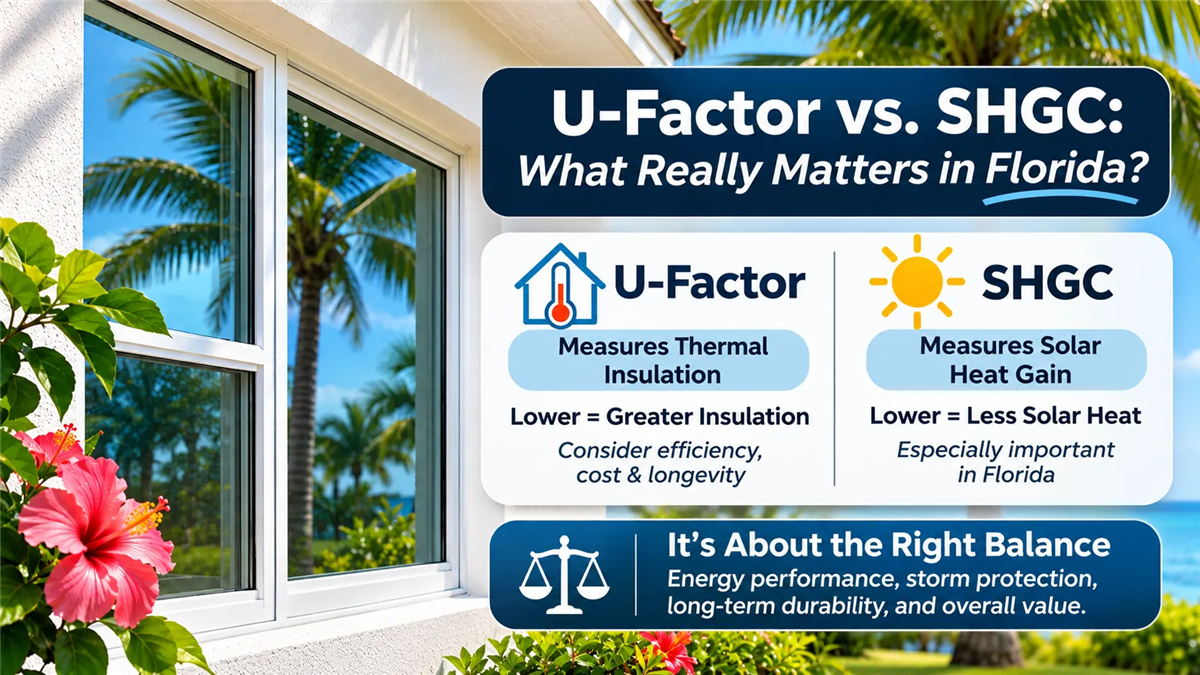
When shopping for hurricane impact windows in Florida, you'll likely encounter two important performance ratings: U-Factor and Solar Heat Gain Coefficient (SHGC).
Both measure important aspects of window energy performance, but they tell very different stories.
U-Factor measures how readily heat transfers through a window due to temperature differences, while SHGC measures how much solar energy enters your home as heat.
Understanding these ratings is particularly important in South Florida, where intense sunlight and long cooling seasons create different priorities than those found in colder climates.
However, neither rating tells the complete story about a window's performance, durability, or long-term value.
Let's explore what these measurements actually mean, why they matter in Florida, and how to evaluate them when choosing replacement impact windows.
What Is U-Factor in an Impact Window?
U-Factor measures the rate at which heat transfers through a window assembly because of temperature differences between the inside and outside of your home.
The lower the U-Factor, the greater the window's resistance to this type of heat transfer.
For example, a window with a lower U-Factor generally provides better thermal insulation than a comparable window with a higher rating.
In colder climates, where homeowners spend considerable energy heating their homes, reducing heat loss through windows is particularly important.
In Florida, where air conditioning is often the primary climate-control concern, thermal insulation remains beneficial, but it represents only one part of overall window energy performance.
That's because Florida homeowners must also consider heat entering their homes directly from the sun.
And that's where another important rating comes into play.
What Is Solar Heat Gain Coefficient (SHGC)?
Solar Heat Gain Coefficient, commonly referred to as SHGC, measures the fraction of solar energy that passes through a window and contributes to indoor heat gain.
A lower SHGC indicates that less solar heat enters your home.
This is especially relevant in Florida, where strong sunlight can significantly influence indoor temperatures and air-conditioning demand.
Consider a South Florida home with large windows facing west.
During the afternoon, direct sunlight can heat the interior of the home, potentially making rooms uncomfortable even while the air conditioner is operating.
Windows designed to reduce solar heat gain can help limit that effect, improving indoor comfort and potentially reducing cooling demand.
Unlike U-Factor, which measures temperature-driven heat transfer, SHGC specifically addresses heat gained from sunlight.
For homeowners in hot, sunny climates like South Florida, solar heat control is an especially important consideration when selecting replacement windows.
However, this doesn't mean U-Factor is irrelevant. Both measurements contribute to overall window performance and should be evaluated together.
Learn more about controlling solar heat in our article, Low-E Glass on Impact Windows in Florida: Is It Worth It?
U-Factor vs. SHGC: Understanding the Difference
Although both ratings relate to energy efficiency, they measure different characteristics.
| Characteristic | U-Factor | SHGC |
|---|---|---|
| What It Measures | Heat transfer caused by temperature differences | Solar energy entering the home as heat |
| What a Lower Rating Means | Greater thermal insulation | Less solar heat gain |
| Primary Benefit | Reduces heat transfer through the window | Helps reduce heating from direct and indirect sunlight |
| Florida Consideration | Contributes to thermal comfort and cooling efficiency | Particularly relevant because of intense sunshine and extended cooling seasons |
A window can provide meaningful solar heat control without having the lowest available U-Factor.
Similarly, a window with excellent thermal insulation does not automatically provide the best solar-control performance.
That's why comparing only one rating can give homeowners an incomplete understanding of their options.
Why Window Construction Matters Just as Much as Energy Ratings
Energy ratings are important, but they don't tell you everything about how a window is constructed.
For hurricane impact windows, the type of glass assembly can influence thermal performance, sound reduction, durability considerations, and cost.
Two common configurations are traditional laminated impact glass and insulated laminated impact glass.
Traditional Laminated Impact Glass
Traditional laminated impact glass consists of multiple glass layers bonded together using a durable polymer interlayer.
The interlayer helps hold broken glass together, an important feature of properly approved hurricane impact window systems.
Because the glass layers are bonded together, this construction does not have the sealed insulating airspace typically found in insulated glass units.
As a result, traditional laminated glass generally provides less thermal insulation than comparable insulated glass configurations.
However, laminated glass can still incorporate solar-control features, including specialized coatings or tinted glass, depending on the product.
That means effective solar heat control does not necessarily require an insulated glass cavity.
Insulated Laminated Impact Glass
Insulated laminated impact glass incorporates an additional sealed space between separate glazing layers.
This space may contain air or another insulating gas, depending on the manufacturer's design.
The insulating cavity helps reduce heat transfer through the window, often resulting in lower U-Factor ratings.
These configurations can provide additional thermal comfort benefits, particularly where temperature differences between indoors and outdoors are significant.
However, the insulating cavity also changes the construction of the window and introduces additional long-term considerations.
For a more detailed explanation of these two configurations, visit our guide to laminated vs. insulated impact glass in Florida.
Does a Lower U-Factor Always Mean a Better Impact Window?
Not necessarily.
A lower U-Factor means better thermal insulation, but it does not automatically mean a window is better in every category.
Window performance involves several characteristics that are not captured by U-Factor alone.
These include:
- Hurricane resistance: The ability of an approved window system to withstand specified structural pressures and impact testing.
- Solar heat control: The amount of solar energy entering the home through the glass.
- Air leakage: How effectively the complete window assembly limits unwanted airflow.
- Acoustic performance: How effectively the window reduces sound transmission.
- Long-term durability: How the glass, frame, seals, and other components perform over time.
- Cost and value: The relationship between purchase price, performance benefits, warranty protection, and long-term ownership considerations.
A window that performs exceptionally well in one category may have different advantages or tradeoffs in another.
For Florida homeowners, evaluating the complete window system is generally more useful than focusing on a single energy-performance measurement.
Understanding the Long-Term Durability of Different Glass Configurations
One consideration homeowners sometimes overlook when comparing glazing options is how the glass assembly is constructed and maintained over time.
Insulated glass units rely on perimeter seals to maintain the integrity of the insulating cavity between their panes.
These seals are designed to provide years of service, but like other building components, they can deteriorate under certain circumstances.
Factors such as product design, manufacturing quality, environmental exposure, thermal movement, and installation conditions can influence long-term performance.
What Happens if an Insulated Glass Seal Fails?
If an insulated glass seal loses its integrity, moisture may enter the cavity between the panes.
This can sometimes lead to:
- Condensation or fogging between the panes.
- A cloudy appearance that cannot be cleaned from the exposed glass surfaces.
- Changes in the insulating unit's thermal performance.
- The need for replacement of the affected glass unit.
Florida's combination of sunshine, heat, and humidity makes long-term durability an important consideration when evaluating window products.
However, insulated glass seal failure is not inevitable, and quality insulated glass units can provide reliable performance for many years.
Actual service life depends on the specific product, installation, environmental conditions, and maintenance.
How Is Traditional Laminated Glass Different?
Traditional non-insulated laminated glass does not contain the same sealed insulating cavity.
Consequently, the specific failure mechanism involving moisture entering an insulated glass cavity does not apply to that construction.
This can be a relevant consideration for homeowners evaluating different glazing designs.
However, the absence of an insulating cavity should not be interpreted as proof that traditional laminated glass will necessarily last longer than insulated glass.
Laminated glass and other window components can still experience deterioration, including edge damage, delamination, hardware wear, or sealant problems.
Neither construction is inherently maintenance-free, and neither should be judged solely by one potential failure mechanism.
For additional information, see our article on impact window seal failure, common warning signs, and what Florida homeowners should know.
How Important Is Low-E Glass for Florida Impact Windows?
Low-emissivity glass, commonly referred to as Low-E glass, uses specialized coatings to influence radiant heat transfer.
Depending on the coating and glass configuration, Low-E technology can improve solar-control performance, thermal performance, or both.
One common misconception is that Low-E glass and insulated glass are the same thing.
They aren't.
Low-E describes a type of coating, while insulated glass describes a glazing assembly containing separate panes and a sealed insulating cavity.
Certain laminated impact glass configurations can incorporate Low-E or other solar-control technologies without the need for an insulated cavity.
However, not all Low-E coatings provide identical performance.
Homeowners should compare the actual ratings of available glass packages rather than assuming all Low-E products deliver the same results.
To explore the differences between glass treatments, read our comparison of tinted vs. Low-E impact windows in Florida.
Choosing Impact Windows for Florida's Climate
Florida's climate presents unique considerations for residential window performance.
Strong sunlight, high temperatures, humidity, and extended air-conditioning use all influence how homeowners experience their windows.
However, not every Florida home has the same needs.
Consider Your Home's Sun Exposure
Windows facing east and west can receive substantial direct sunlight at different times of day.
Homes with large glass openings may experience more solar heat gain than homes with smaller or heavily shaded windows.
Glass with appropriate solar-control characteristics may help improve comfort in these situations.
Consider Your Existing Windows
The benefits of replacement windows also depend on what is being replaced.
Older, poorly sealed, or deteriorating windows may contribute to unwanted air leakage and reduced indoor comfort.
Replacing these windows with properly installed products can offer benefits beyond differences in U-Factor or SHGC alone.
Consider Your Priorities
Some homeowners prioritize the strongest available thermal insulation.
Others place greater emphasis on solar heat protection, hurricane resistance, noise reduction, long-term durability, or overall affordability.
There is no single glass configuration that automatically represents the best value for every home.
The right window is the one that meets applicable requirements while balancing performance, protection, and the homeowner's individual priorities.
Do Impact Windows Need to Meet Florida Energy-Code Requirements?
Yes. Replacement impact windows must satisfy applicable Florida Building Code requirements, including relevant energy-efficiency provisions.
Florida's residential energy code establishes standards for solar heat gain and, depending on the climate zone and compliance method, thermal insulation.
However, compliance isn't always determined by evaluating a single window's SHGC or U-Factor in isolation.
Depending on the project, available compliance methods may include area-weighted calculations, applicable exceptions, or alternative energy-performance approaches.
That's why homeowners should evaluate the complete window system and work with a qualified contractor to determine which products meet their project's requirements.
A window's SHGC or U-Factor alone doesn't establish whether it's approved for installation in your home.
It's also important to distinguish between hurricane impact approval and energy-code compliance.
A Florida product approval or Miami-Dade Notice of Acceptance addresses the product's approved performance and permitted applications, but it does not automatically establish compliance with every applicable energy requirement.
Homeowners can find additional information through the Florida Building Commission.
What Should You Compare When Shopping for Impact Windows?
Rather than concentrating exclusively on one energy-efficiency number, homeowners should review several characteristics of the complete window system.
- Impact Protection: Verify that the complete system has the appropriate Florida product approval or Miami-Dade Notice of Acceptance for the intended installation.
- Solar Heat Gain Coefficient: Understand how the glass limits incoming solar heat and whether it satisfies applicable energy requirements.
- U-Factor: Compare the thermal insulation performance of available configurations.
- Glass Construction: Understand whether the product uses traditional laminated glass, insulated laminated glass, or another approved configuration.
- Air Leakage: Consider the window's air-infiltration performance and the importance of proper installation.
- Warranty Coverage: Review the manufacturer's coverage for glass, frames, seals, hardware, and other components.
- Long-Term Value: Consider the total cost of the product alongside its performance benefits, durability characteristics, and warranty protection.
For additional guidance, see our article on how to tell if your windows are impact-rated in Florida.
Frequently Asked Questions About U-Factor and SHGC
Is a lower U-Factor always better for Florida impact windows?
A lower U-Factor indicates better thermal insulation, but it doesn't necessarily make a window the better overall purchase. Homeowners should also evaluate solar heat control, hurricane protection, durability, warranty coverage, and cost.
Is SHGC more important than U-Factor in Florida?
SHGC is particularly relevant in Florida because of the state's intense sunshine and long cooling season. However, U-Factor remains important for overall thermal performance. Both measurements should be considered when comparing windows.
Do laminated impact windows provide energy efficiency?
Yes. Depending on their glass configuration and coatings, laminated impact windows can provide useful solar-control performance. Thermal insulation and solar heat control are different characteristics, so homeowners should review both U-Factor and SHGC.
Are insulated impact windows better than traditional laminated impact windows?
Insulated laminated impact glass generally provides better thermal insulation, while traditional non-insulated laminated glass has a simpler glazing construction without a sealed insulating cavity. Neither option is automatically better in every situation. The best choice depends on the product, performance requirements, and homeowner priorities.
Can insulated impact window seals fail?
Yes. Insulated glass units contain perimeter seals that can deteriorate over time. However, failure is not inevitable, and many properly manufactured and installed units perform reliably for years. Manufacturer warranty coverage is an important consideration.
Are Low-E impact windows always insulated?
No. Low-E refers to a specialized glass coating rather than an insulated glass construction. Certain laminated impact glass configurations can incorporate Low-E or other solar-control technologies without a sealed insulating cavity.
Will installing energy-efficient impact windows lower my electric bill?
Energy-efficient replacement windows may help reduce heating or cooling demand, particularly when replacing older or poorly performing windows. Actual savings depend on the existing windows, home construction, sun exposure, HVAC system, installation quality, and household energy usage.
The Bottom Line: Energy Ratings Are Important, but They Aren't Everything
U-Factor and SHGC are valuable tools for understanding how windows perform.
A lower U-Factor means greater thermal insulation, while a lower SHGC means less solar heat enters your home.
In Florida's hot, sunny climate, solar heat control deserves particular consideration.
However, the energy ratings of a window don't tell the entire story about hurricane protection, durability, maintenance, or long-term value.
Different glass configurations offer different advantages, and homeowners should understand those differences before making a decision.
Rather than focusing exclusively on the lowest available U-Factor or any single performance measurement, consider the complete window system and how it fits your home's specific needs.
The best impact window investment is one that provides the right combination of storm protection, energy performance, durability, comfort, and overall value.
Explore Impact Window Options with Statewide Windows & Doors
At Statewide Windows & Doors, we help South Florida homeowners explore replacement impact window and door options based on their needs, preferences, and budgets.
Whether you're looking to improve hurricane protection, enhance indoor comfort, or explore energy-efficient glass options, understanding the available products is an important first step.
Our team can help you compare available window options and identify products suited to your home.
Contact Statewide Windows & Doors today to schedule your free impact window estimate.
Tags
Subscribe to Statewide Windows & Doors's Blog




Comments