 Free Estimate
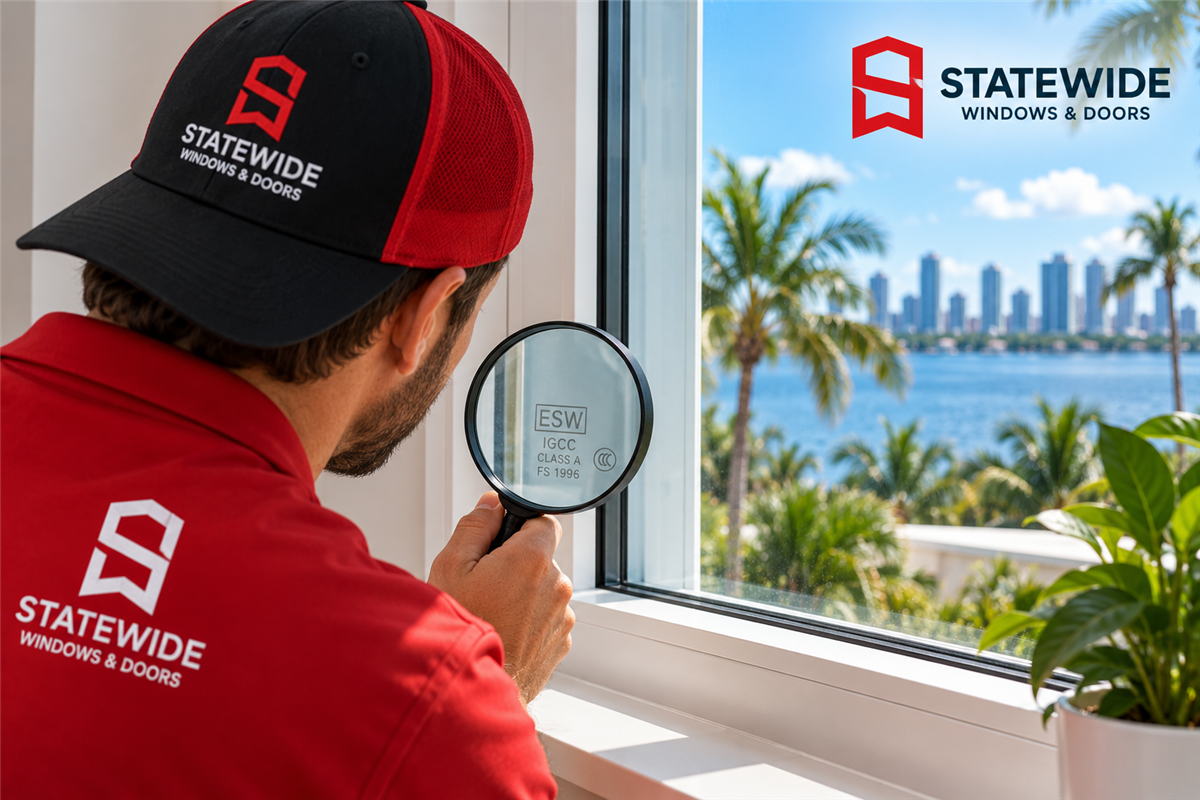
Many Florida homeowners know that their home has newer windows, but they may not know whether those windows are actually impact-rated.
This is especially common when someone purchases a home after the windows were installed by a previous owner.
A window may look strong, have thick glass, or appear newer than the rest of the home, but appearance alone does not prove that it is an approved impact-resistant window.
Likewise, terms such as "hurricane window," "storm window," "tempered glass," and "impact glass" should not automatically be treated as interchangeable.
If you want to determine whether your existing windows are impact-rated, the best approach is to identify the product and look for documentation that supports the specific window configuration.
Here is what Florida homeowners should know.
What Does "Impact-Rated" Actually Mean?
An impact-rated window is not simply a window made with thicker glass.
Impact-resistant windows are manufactured as complete systems designed and tested for specified conditions.
Depending on the product, the complete system can include:
- Impact-resistant glazing
- Frame
- Sash
- Hardware
- Locks
- Fasteners
- Anchoring requirements
- Specific dimensions and configurations
The complete approved configuration matters.
Can You Tell an Impact Window Just by Looking at It?
Not reliably.
Some impact windows may look very similar to non-impact replacement windows.
A modern frame, tinted glass, large panes, or substantial construction can provide clues about the type of product, but none of these features alone confirms impact approval.
Documentation and product identification are more reliable than appearance.
Start by Looking for a Permanent Glass Marking
One place homeowners can inspect is the glass itself.
Depending on the product, permanent markings may appear near a corner or edge of the glass.
These markings can contain information related to the glass manufacturer, safety-glazing standard, or other product characteristics.
The exact markings vary, so homeowners should not expect every impact window to display identical wording.
A marking can provide useful identification information, but it should be interpreted in the context of the complete window.
Look Around the Window Frame for Labels
Manufacturer labels or product-identification information may also appear on the frame, sash, track, or another location depending on the product.
Some information may be visible when an operable window is opened.
Useful information can include:
- Manufacturer name
- Product or series information
- Model information
- Certification information
- Other identifying numbers or codes
If you find a label, take a clear photo before attempting to research the product.
Do Not Remove Labels Just to Read Them
If a product label is difficult to access, homeowners should avoid damaging the frame, sash, weatherstripping, or other components simply to retrieve it.
Take photos of whatever information is visible.
If the window requires professional identification, those photos may help a contractor or manufacturer determine what product is installed.
Does Laminated Glass Mean a Window Is Impact-Rated?
Not automatically.
Laminated glass is an important component of many impact-resistant glazing systems, but identifying laminated glass alone does not establish that the entire window is an approved impact-resistant system for a particular application.
The frame, hardware, dimensions, installation, and complete tested configuration also matter.
This is why homeowners should avoid assuming that "laminated" automatically means "approved hurricane impact window."
What Is Laminated Impact Glass?
Laminated glass generally uses layers of glass bonded with an interlayer.
If the glass is damaged, the interlayer can help hold broken glass together rather than allowing the opening to behave like ordinary shattered glass.
Impact-resistant window systems can use laminated glazing as part of their construction.
However, the exact glazing configuration varies by manufacturer and product.
Can You See the Interlayer in Impact Glass?
Sometimes the edge construction of laminated glazing may be visible depending on the window and installation.
However, homeowners should not rely on a visual edge inspection as their only method of identifying an impact window.
Different glazing configurations can look similar.
Product documentation provides much stronger evidence.
Is Tempered Glass the Same as Impact Glass?
No.
Tempered glass and laminated impact-resistant glazing should not automatically be treated as the same product.
Tempered glass is manufactured to break differently from ordinary annealed glass when it fails.
Impact-resistant glazing is designed as part of a system intended to meet applicable impact-testing requirements.
A marking indicating tempered glass alone does not prove that the window is an approved impact-resistant window.
Does Thick Glass Mean It Is Impact Glass?
No.
Glass thickness alone is not enough to identify an impact-rated window.
Several types of glazing can appear thick, particularly insulated glass units that use multiple panes.
An insulated window may be energy efficient without necessarily being impact-rated.
Similarly, an impact-resistant window can use a more complex glazing configuration than a homeowner can identify visually.
Is Double-Pane Glass Automatically Impact-Rated?
No.
Double-pane or insulated glass generally refers to a glazing assembly using multiple panes separated by a sealed space.
This construction is commonly associated with thermal performance.
Impact resistance is a separate characteristic.
An insulated impact window can combine both technologies, but ordinary insulated glass should not automatically be described as impact-resistant.
Is Low-E Glass Impact-Rated?
Low-E refers to a coating designed to influence thermal and solar energy transfer through glass.
It does not by itself establish impact resistance.
A window can have Low-E glass without being an impact window, while an impact window can also incorporate Low-E technology depending on the available configuration.
Homeowners should evaluate these as separate product characteristics.
Does Argon Gas Mean the Window Is Impact-Rated?
No.
Argon may be used in the sealed space of certain insulated glass units to contribute to thermal performance.
It does not determine whether the window is impact-resistant.
An impact window may use an argon-filled insulated glass configuration, but the presence of argon alone is not proof of impact approval.
Can a Window Have Hurricane Protection Without Being Impact Glass?
Florida homes can use different methods of protecting glazed openings depending on applicable requirements and the property.
For example, some homes may have non-impact windows that rely on an approved protective system installed over the openings when needed.
Therefore, a home described as having hurricane protection does not automatically mean every window is impact-resistant.
Statewide Windows & Doors specializes in impact windows and doors and does not sell hurricane shutters.
Check Your Original Window Contract
If you were the homeowner when the windows were installed, your project paperwork may be one of the easiest places to start.
Look for documentation containing:
- Manufacturer
- Product series
- Window styles
- Glass specifications
- Product approval information
- Contractor information
- Permit information
- Installation date
Do not rely solely on general marketing language if more specific product information is available.
What If a Previous Owner Installed the Windows?
If the windows were installed before you purchased the home, you may not have the original contract.
You can still begin by gathering information from:
- Window labels
- Glass markings
- Permit records
- Inspection documents
- Closing documents
- Previous homeowner records
- Manufacturer information
Combining several sources can help identify what was installed.
Check Permit Records
Replacement window projects commonly require permits depending on the jurisdiction and scope of work.
Permit records may contain useful information about a previous window replacement project.
Depending on the jurisdiction and age of the project, records may include information such as:
- Contractor
- Permit date
- Scope of work
- Product documentation
- Inspection information
- Permit status
The amount of information available online varies by jurisdiction.
Does Having a Window Permit Prove the Windows Are Impact-Rated?
Not by itself.
A permit establishes that work was permitted under the scope and documentation associated with that project.
Homeowners should review what products were actually documented rather than assuming the existence of a permit alone proves every window is impact-resistant.
The exact product information is what matters.
What Is a Product Approval?
Florida uses product-approval systems to document building products that have demonstrated compliance with applicable requirements.
For windows and doors, homeowners may encounter references to:
- Florida Product Approval
- Miami-Dade Notice of Acceptance
- Product approval numbers
- Approved installation details
The approval documentation can help identify the specific products and configurations evaluated for use.
What Is a Miami-Dade NOA?
A Miami-Dade Notice of Acceptance, commonly called an NOA, is one recognized product-approval pathway used for certain building products.
Homeowners in South Florida frequently encounter NOA documentation when researching impact windows and doors.
However, homeowners should not assume that every impact window everywhere in Florida must have a Miami-Dade NOA.
The applicable approval depends on the product, configuration, jurisdiction, and intended application.
What Is Florida Product Approval?
Florida Product Approval is another product-approval pathway homeowners may encounter when researching windows and doors.
The important step is not simply finding a Florida approval number.
Homeowners should verify whether the specific product and configuration are appropriate for the intended application.
This becomes especially important for projects within Florida's High-Velocity Hurricane Zone.
Miami-Dade and Broward County Have Additional Considerations
Miami-Dade and Broward County are located within Florida's High-Velocity Hurricane Zone, commonly called the HVHZ.
Products used for applicable projects in these areas must meet the requirements relevant to their intended application.
A Miami-Dade NOA is one recognized pathway, while qualifying Florida Product Approvals specifically approved for HVHZ use can also apply.
A generic Florida Product Approval should not automatically be interpreted as approval for every HVHZ application.
Learn more in our guide to Miami-Dade NOA vs. Florida Product Approval.
Can You Search a Product Approval Number?
Yes.
If you locate a valid product-approval reference associated with the window, you may be able to research the applicable approval documentation.
When reviewing an approval, pay attention to more than the manufacturer name.
Look for information related to:
- Product series
- Window type
- Dimensions
- Glazing
- Design pressures
- Installation requirements
- Approved configurations
A manufacturer may produce many different products, so the company name alone is not enough.
Why the Exact Window Configuration Matters
One product series can potentially have multiple configurations.
Differences can include:
- Window dimensions
- Glass type
- Frame configuration
- Window style
- Design pressure
- Anchoring
- Installation conditions
That is why homeowners should avoid saying, "This manufacturer makes impact windows, so mine must be impact."
You need to identify the specific product.
Does the Brand Name Prove a Window Is Impact-Rated?
No.
A manufacturer may produce several types of windows and doors.
Some products may be impact-resistant while others may have different applications or configurations.
Knowing the manufacturer is useful, but homeowners should continue identifying the specific product or series.
Can a Contractor Identify an Existing Impact Window?
An experienced window professional may be able to help identify existing windows using labels, markings, construction details, and available documentation.
However, homeowners should be cautious of anyone who makes an absolute determination from a quick visual glance without identifying the product.
When documentation exists, it should be used.
Can You Test a Window at Home to See If It Is Impact Glass?
Homeowners should not strike, hit, drill, scratch, remove, or otherwise damage a window to determine whether it is impact-resistant.
Do not attempt an improvised "impact test."
Actual product testing is performed under controlled procedures and should not be recreated on an installed residential window.
Use markings and documentation instead.
Do Not Use the "Tap Test"
Some homeowners are told they can tap on glass and determine whether it is impact-rated based on the sound.
This is not a reliable method for verifying the complete window system.
Glass construction, thickness, insulated units, dimensions, and other factors can affect how a window sounds.
Product identification is much more useful than guessing based on sound.
Do Not Assume a Heavy Window Is Impact-Rated
Impact windows can feel substantial because of their glazing and construction.
But weight alone is not proof.
Large insulated windows and other window systems can also be heavy.
The correct approach is to identify the product and supporting documentation.
Does a Window Installed After a Certain Year Automatically Mean Impact?
No.
The age of a window alone does not prove its exact glazing or approval configuration.
Building requirements vary based on location, project type, code edition, building conditions, and other factors.
A newer-looking window should not automatically be assumed to be impact-resistant without further verification.
What About New Construction Homes?
Homeowners purchasing newer construction should still review the specifications for the installed windows and doors.
Do not assume every glazed opening uses impact-resistant glazing simply because the home is newer or located in Florida.
Review the building documents, product information, and hurricane-protection strategy applicable to the home.
What About Condos?
Condominium owners may be able to obtain information from several sources.
Depending on the property, useful records can include:
- Association documents
- Previous renovation approvals
- Permits
- Window manufacturer information
- Previous owner records
- Property management records
Condo owners should also remember that HOA or association approval is separate from government permitting and product approval.
Are Impact Windows Always Tinted?
No.
Glass appearance varies by product and selected options.
Some impact windows may have visible tinting, while others can appear relatively clear.
Low-E coatings and other glass technologies can also change appearance.
Tint should not be used as proof of impact resistance.
Are Impact Windows Always Double Pane?
No.
Impact-resistant glazing and insulated glazing describe different product characteristics.
Some impact windows can incorporate insulated glass, while other approved impact configurations may use different constructions.
The exact product documentation should be reviewed.
Are All Hurricane Windows Impact Windows?
The phrase "hurricane window" is often used casually in advertising and homeowner conversations.
Because the term can be used broadly, homeowners should look beyond the label.
Ask for the specific product, glazing configuration, approval, and intended application.
Technical documentation is more useful than marketing terminology.
What If You Cannot Find Any Labels?
Missing or unreadable labels do not automatically mean a window is not impact-rated.
Older installations may have labels that are difficult to locate or read.
If labels are unavailable, homeowners can investigate:
- Permit records
- Original contracts
- Previous homeowner documents
- Manufacturer records where available
- Property management records
- Professional product identification
Use multiple sources rather than making an assumption.
What If the Permit Says "Window Replacement" but Does Not List the Product?
Older or publicly accessible permit summaries may provide only limited information.
A short online description may not include all documents originally submitted for the project.
Depending on the jurisdiction and age of the permit, additional records may exist beyond the public summary.
If confirmation is important, homeowners can investigate whether more detailed project records are available.
Why Design Pressure Matters
Even after confirming that a window is an impact-resistant product, homeowners should understand that product suitability involves more than impact glass.
The specific configuration must also be appropriate for the pressures associated with the opening and project.
Window size, location on the building, building characteristics, and other factors can influence required design pressures.
That is another reason the exact product documentation matters.
Can an Impact Window Lose Its Rating?
Homeowners should avoid describing impact approval as something that simply "wears off" after a certain number of years.
However, damage, improper modifications, incompatible replacement components, or other changes can affect a window system.
If an impact window has been significantly damaged or modified, it should be evaluated rather than assuming it remains in its original condition.
Be Careful With Replacement Glass
If glass has previously been replaced, homeowners should verify what was installed.
Impact windows use specific glazing configurations.
Ordinary replacement glass should not be substituted simply because it physically fits the frame.
If you are uncertain about previous glass replacement work, professional evaluation may be appropriate.
Be Careful With Modified Hardware
The same principle applies to other components.
Impact window systems can use specific:
- Locks
- Fasteners
- Hardware
- Glazing
- Anchoring
- Frame components
Unverified modifications can make it more difficult to determine whether the installed window still matches its original approved configuration.
Why Verification Matters Before Hurricane Season
Homeowners should understand how their home is intended to protect its glazed openings before severe weather approaches.
If you recently purchased a Florida home and do not know whether the windows are impact-rated, investigate before a storm is approaching.
This gives you time to locate records, identify products, and understand whether any additional hurricane-protection measures are used by the property.
Why Verification Matters When Buying a Florida Home
If a seller or listing describes a property as having "impact windows," buyers may want documentation supporting that description.
Useful information can include:
- Manufacturer and product information
- Installation contract
- Permit records
- Product approvals
- Installation date
- Warranty documents
This information can also be valuable for future maintenance and service.
What Should You Ask a Seller About Existing Impact Windows?
Questions can include:
- When were the windows installed?
- Who installed them?
- Do you have the original contract?
- What manufacturer was used?
- Are all windows impact-rated or only some?
- Were the doors replaced too?
- Was the project permitted?
- Do you have warranty documents?
- Has any glass been replaced since installation?
- Have any windows required service?
Impact Windows vs. Impact Doors
The same general verification principle applies to doors.
A strong-looking entry door or sliding glass door should not automatically be assumed to be impact-rated.
Identify the exact product and applicable documentation.
Explore impact doors from Statewide Windows & Doors and impact sliding glass doors.
A Simple Impact Window Verification Checklist
If you are trying to determine whether existing windows are impact-rated, work through this checklist:
- Inspect the glass for permanent markings.
- Look for manufacturer or product labels on the frame or sash.
- Photograph any numbers, codes, or names you find.
- Locate the original window contract if available.
- Review permit records for the replacement project.
- Identify the manufacturer and exact product series.
- Locate applicable product-approval documentation.
- Confirm the specific configuration rather than only the manufacturer.
- Check whether any glass or hardware was replaced later.
- Ask an experienced window professional for help if documentation remains unclear.
Common Myths About Identifying Impact Windows
"If the Glass Is Thick, It Is Impact Glass"
False. Thickness alone does not establish impact resistance.
"Double-Pane Means Impact"
False. Insulated glazing and impact resistance are different characteristics.
"Tempered Glass Is the Same as Impact Glass"
False. Tempered and impact-resistant glazing should not automatically be treated as equivalent.
"If the Manufacturer Makes Impact Windows, Every Window They Sell Is Impact-Rated"
False. The specific product and configuration must be identified.
"A Florida Product Approval Automatically Means It Works Everywhere in Florida"
Too broad. The exact approval, configuration, intended application, and HVHZ requirements where applicable must be considered.
"You Can Tell by Tapping on the Glass"
False. Sound is not a reliable substitute for product documentation.
How Statewide Windows & Doors Helps Florida Homeowners
Statewide Windows & Doors helps Florida homeowners replace existing windows and doors with impact-resistant systems selected for their property's requirements.
Our team works with homeowners across product selection, project coordination, permitting, installation, inspections, and customer service.
When choosing new impact windows, homeowners can review the actual product information rather than relying on guesswork about what is installed.
Statewide has more than 25 years of combined industry experience and has completed thousands of projects across Miami-Dade and Broward County while serving homeowners throughout Florida.
Explore our impact window options, impact doors, completed projects, and Florida service areas.
Why Choose Statewide Windows & Doors?
Replacing windows in Florida involves more than choosing glass that looks strong.
Product approvals, glazing, frames, design pressures, installation requirements, permitting, inspections, warranties, and customer service can all be important parts of the project.
Statewide Windows & Doors helps homeowners understand these considerations and select impact window and door products appropriate for their project.
Final Words
You cannot reliably determine whether a Florida window is impact-rated simply by looking at how thick, new, tinted, or strong it appears.
The most reliable approach is to identify the specific window and review supporting documentation.
Start with glass markings and frame labels, then check contracts, permits, manufacturer information, and applicable product approvals.
Remember that laminated glass, tempered glass, insulated glass, Low-E coatings, and argon gas describe different characteristics and do not individually prove that a complete window is impact-rated.
For Miami-Dade and Broward County homes, verifying the exact product and configuration is particularly important because these counties are within Florida's High-Velocity Hurricane Zone.
If you cannot determine what is installed, an experienced impact window professional can help you investigate the existing products and discuss replacement options if necessary.
Tags
Subscribe to Statewide Windows & Doors's Blog




Comments