If you're replacing windows or doors in South Florida, you may hear terms like Miami-Dade NOA, Florida Product Approval, HVHZ, impact-rated, design pressure, and product approval used interchangeably.
They don't all mean the same thing. One of the most common misconceptions is that every window or door installed in Miami-Dade or Broward County must have a Miami-Dade Notice of Acceptance (NOA), and that a Florida Product Approval is automatically insufficient.
That's not an accurate way to understand Florida's product-approval system.
Both approval pathways can be relevant in the High-Velocity Hurricane Zone. What matters is whether the specific product and configuration is approved for the location and application where it will be installed.
For South Florida homeowners, understanding that distinction can make it much easier to evaluate products, proposals and contractors.
What Is the High-Velocity Hurricane Zone (HVHZ)?
Florida's High-Velocity Hurricane Zone, commonly abbreviated as HVHZ, consists specifically of:
- Miami-Dade County
- Broward County
While other parts of Florida are subject to significant wind-load and wind-borne debris requirements, they are not part of the Florida Building Code's designated HVHZ.
Miami-Dade and Broward are subject to specific provisions of the Florida Building Code addressing the severe wind conditions associated with hurricanes.
The HVHZ has additional code provisions and product-testing requirements that make it particularly important to verify that windows, doors and other building-envelope products are approved for the intended application.
For a homeowner replacing windows or doors in Miami-Dade or Broward, simply hearing that a product is “Florida approved” isn't enough information. Homeowners planning a South Florida project can also learn more about our Miami impact window installation services.
The next question should be:
Is this specific product approved for use in the HVHZ?
What Is a Miami-Dade Notice of Acceptance (NOA)?
A Miami-Dade Notice of Acceptance, or NOA, is a product approval issued through Miami-Dade County's product-control process.
NOAs are widely recognized throughout the Florida construction industry, particularly for products intended for use in high-wind environments.
A Miami-Dade NOA contains important information about a product and its approved use, which may include:
- Product models and configurations
- Applicable testing
- Maximum sizes
- Design pressures
- Glass or glazing configurations
- Installation requirements
- Anchorage requirements
- Approved substrates
- Limitations and conditions of use
- Approval and expiration information
The important point is that an NOA isn't simply a marketing certification.
It is a technical approval document, and the details contained in that approval matter.
Two windows from the same manufacturer may have different approvals, limitations, sizes or design pressures.
That's why knowledgeable contractors evaluate the actual approved configuration, rather than simply saying a manufacturer is “Miami-Dade approved.”
What Is a Florida Product Approval?
Florida also operates a statewide product-approval system through the Florida Building Commission.
Products covered by Florida's product-approval requirements can receive a Florida Product Approval, commonly identified by an FL number.
The Florida Building Code Information System maintains a searchable database where approved products and their supporting documentation can be reviewed.
A Florida Product Approval can contain information such as:
- Manufacturer
- Product category
- Product model
- Approval status
- Applicable standards
- Installation instructions
- Evaluation or certification documentation
- Design-pressure information
- Impact-resistance information
- Conditions and limitations of use
And, critically for South Florida:
The Florida Product Approval database specifically identifies whether a product is approved for use in the HVHZ.
That distinction is extremely important.
Does Miami-Dade or Broward Require a Miami-Dade NOA?
This is where much of the confusion begins.
A Miami-Dade NOA is one recognized approval pathway for products used in the HVHZ.
But it is incorrect to assume that only a Miami-Dade NOA can establish product approval for use in Miami-Dade or Broward.
Florida Building Commission guidance recognizes that products may be approved for HVHZ use through the state's product-approval process when the applicable requirements are satisfied.
In practical terms:
A qualifying Florida Product Approval that specifically includes approval for use in the HVHZ can be used as an approval pathway for an HVHZ product.
A product does not become unacceptable merely because its approval is identified with an FL number instead of only being presented as a Miami-Dade NOA.
The key is what the approval actually says.
Not Every Florida Product Approval Is an HVHZ Approval
This distinction is just as important.
A homeowner should not assume:
“It has a Florida Product Approval, so it can automatically be installed anywhere in Florida.”
That isn't how the system works.
The Florida Product Approval database distinguishes between products that are:
- Approved for use in HVHZ: Yes
- Approved for use in HVHZ: No
A product can therefore have a legitimate Florida Product Approval while not being approved for use in Miami-Dade or Broward's HVHZ.
This is why homeowners and contractors need to look beyond the existence of an FL number.
The approval's limits and conditions of use matter.
Florida Product Approval vs. Miami-Dade NOA: The Simple Explanation
For homeowners, the easiest way to understand the distinction is:
Miami-Dade NOA
A product approval issued through Miami-Dade County's product-control process.
Florida Product Approval
A statewide approval issued through Florida's product-approval system.
HVHZ Approval
The critical question for a Miami-Dade or Broward project: whether the specific product and configuration is approved for use in the High-Velocity Hurricane Zone.
An NOA can establish an approved pathway.
A Florida Product Approval can also identify a product as approved for use in the HVHZ.
Therefore, asking only:
“Does this window have a Miami-Dade NOA?”
doesn't necessarily tell you everything you need to know.
A better question is:
“What approval applies to this exact product and configuration, and is it approved for my property and application?”
“Impact Resistant” and “HVHZ Approved” Are Not the Same Thing
Another common mistake is assuming that impact-resistant automatically means HVHZ approved.
These are related concepts, but they aren't interchangeable.
Florida's product database separately identifies characteristics such as:
- Whether a product is impact resistant
- Whether it is approved for use in the HVHZ
- Whether it is approved outside the HVHZ
- Applicable design-pressure information
- Conditions and limitations of use
A product may satisfy one classification without automatically satisfying every requirement for every project.
That is why the actual approval documentation matters.
What About Non-Impact Windows in the HVHZ?
Here's another reason the terminology can become confusing:
A product can potentially be approved for use in the HVHZ while being identified as non-impact.
That does not mean an unprotected non-impact opening automatically satisfies the requirements for a particular home.
Opening protection, glazing, building type, product configuration and other code requirements can affect what is permitted.
The important takeaway is that:
“HVHZ approved” and “impact resistant” describe different characteristics.
Homeowners shouldn't choose a window or door based on a single label without understanding the complete approved assembly and how it will be used.
What Is Design Pressure?
Product approval is only part of selecting the correct window or door.
Another important consideration is design pressure, commonly abbreviated as DP.
Windows and doors must withstand wind pressures acting both toward and away from a building.
The pressure applicable to a particular opening can depend on factors including:
- Building height
- Building dimensions
- Location
- Wind speed
- Exposure
- Opening location on the structure
- Proximity to corners and roof edges
- Product size and configuration
This is why saying:
“This is a hurricane window.”
isn't enough.
A product still needs to be appropriate for the specific opening and installation conditions.
The same product series may be approved at different sizes, configurations and pressures.
Product Approval Is About the Entire Assembly
Another misconception is that approval applies broadly to every product carrying a particular manufacturer's name.
It doesn't work that way.
The approval documentation may specify details such as:
- Window or door type
- Frame configuration
- Glass type
- Maximum dimensions
- Mullions
- Reinforcement
- Anchors
- Anchor spacing
- Substrate
- Installation method
- Design pressures
Changing one of those variables can affect whether the proposed configuration falls within the approval.
That's why homeowners should be cautious when someone simply says:
“We use an approved manufacturer.”
The manufacturer is only the beginning.
The actual product, configuration and installation need to comply with the applicable approval.
Why Installation Matters Just as Much as the Product
Even an appropriately approved impact window or door can only perform as intended when it is installed according to the applicable requirements.
The product approval documentation may establish specific requirements for:
- Anchor type
- Anchor size
- Anchor spacing
- Edge distance
- Embedment
- Substrate
- Mullions
- Bucks
- Installation clearances
- Maximum product dimensions
This is one reason permitting and inspections are an important part of window and door replacement. The approval establishes how the product is permitted to be used, while the installation has to follow those requirements.
You can learn more about our Florida window replacement and impact window services and how Statewide approaches replacement projects throughout Florida.
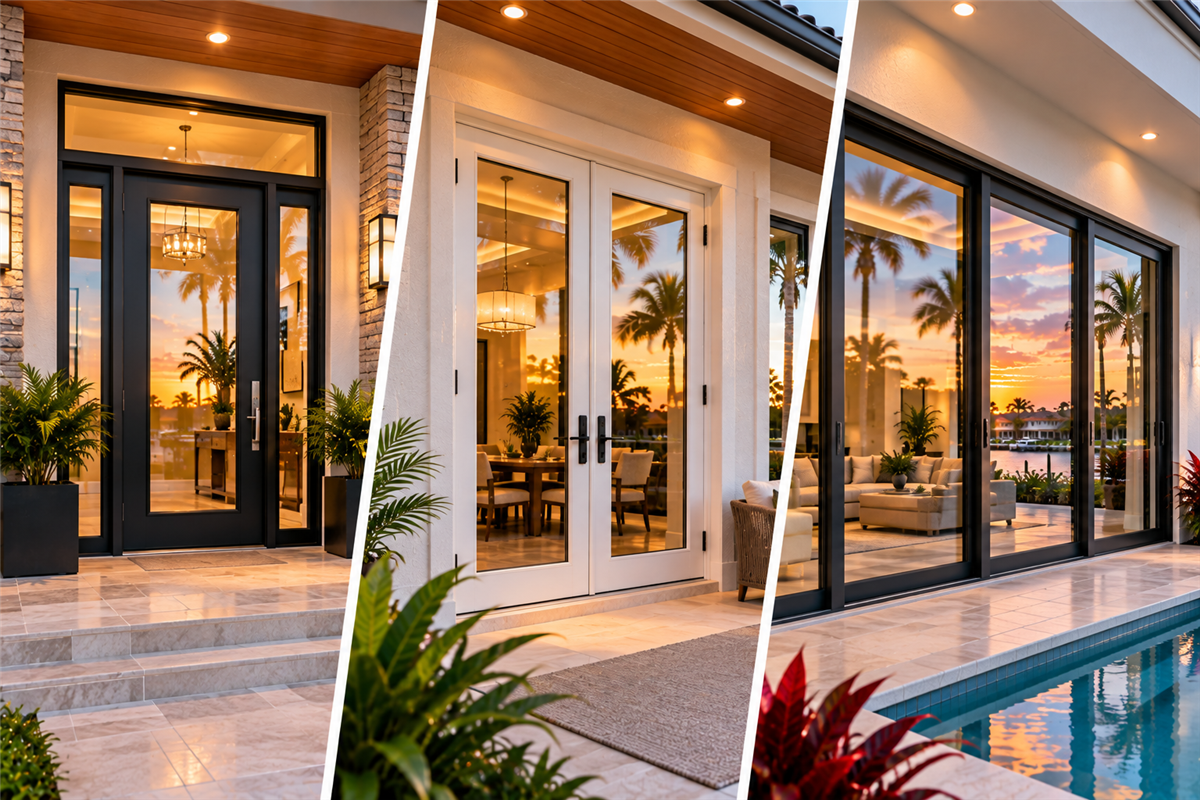
For an example of a completed South Florida project, see this Miami impact window and door replacement project, where Statewide replaced older openings with impact windows, an impact door and a sliding glass door.
What Should a Miami-Dade or Broward Homeowner Ask a Contractor?
You don't need to become a building-code expert before replacing your windows.
But you should be able to ask straightforward questions and receive straightforward answers.
1. What exact window or door system are you proposing?
Ask for the manufacturer and product series.
2. What product approval applies to it?
The contractor should be able to identify the applicable approval documentation.
3. Is this exact product approved for use in the HVHZ?
This is more useful than simply asking whether it is “Florida approved.”
4. Is the proposed configuration appropriate for my opening?
Size, configuration and required design pressures matter.
5. Is the product impact resistant?
Don't assume HVHZ approval and impact resistance mean exactly the same thing.
6. Who is responsible for permitting?
For a permitted replacement project, understand who prepares and submits the necessary documentation.
7. Will the installation follow the approved installation requirements?
The product and installation work together as a system.
How Can Homeowners Verify a Florida Product Approval?
Florida homeowners can search the official Florida Building Code Information System Product Approval database.
Products can be searched using information such as:
- Florida approval number
- Manufacturer
- Product category
- Product model
- Code version
The database also allows users to identify whether a listed product is approved for use in the HVHZ.
For projects in Miami-Dade, homeowners can also review Miami-Dade County's Product Control and Notice of Acceptance resources.
These government databases are much more reliable than relying on generalized claims found in advertising, social media posts or online articles.
Why There Is So Much Confusion About NOAs and Florida Product Approvals
Part of the confusion comes from the fact that Miami-Dade NOAs are extremely well known in the South Florida construction industry.
Many products also have approval documentation that references or incorporates Miami-Dade testing, certification or NOA information.
As a result, terms such as “Miami-Dade approved,” “NOA approved,” “Florida approved,” “HVHZ approved,” and “impact rated” are sometimes casually used as though they all mean the same thing.
They don't.
For homeowners, the safest approach is not to focus on the terminology alone.
Focus on the documentation.
The Bottom Line: Verify the Product, Approval and Application
For window and door projects in Miami-Dade and Broward County, the question isn't simply:
“NOA or Florida Product Approval?”
The better questions are:
- Is the specific product approved for use in the HVHZ?
- Does the approval cover the exact configuration being installed?
- Does the product meet the requirements applicable to the opening?
- Is it being installed according to its approved installation requirements?
A Miami-Dade NOA is an important and widely used product-approval pathway.
A Florida Product Approval should not, however, be dismissed merely because it is a statewide approval. Florida's own product-approval system specifically provides for products approved for use in the HVHZ.
At the same time, simply possessing an FL number does not automatically make a product appropriate for an HVHZ project.
The details of the approval are what matter.
Need Help Choosing the Right Impact Windows for Your South Florida Home?
Understanding the difference between a Miami-Dade NOA, Florida Product Approval and HVHZ approval is important, but homeowners shouldn't have to interpret technical product-approval documents on their own.
At Statewide Windows & Doors, our team helps homeowners evaluate impact window and door options based on the requirements of their home, including product approval, configuration, design pressures, permitting and installation requirements.
We serve homeowners throughout South Florida, including Miami-Dade and Broward County. You can explore our Florida service areas or speak with our team about the requirements for your specific property.
Planning to replace your windows or doors? Request a free estimate from Statewide Windows & Doors and let our team help you compare impact-rated options for your home.
Tags
Subscribe to Statewide Windows & Doors's Blog

Comments