 Free Estimate
When Florida homeowners shop for impact windows, one of the most confusing parts of comparing products can be the glass.
Terms such as laminated glass, insulated glass, impact glass, Low-E glass, and double-pane glass are often used during the buying process, but they do not all mean the same thing.
Two terms homeowners frequently encounter are laminated impact glass and insulated impact glass.
The difference matters because these glass configurations can affect hurricane protection, energy performance, thickness, appearance, noise reduction, and cost.
More importantly, homeowners should understand that impact resistance and insulation are two different characteristics. A window can be designed to address both, but one does not automatically guarantee the other.
Here is what Florida homeowners should know when comparing laminated and insulated impact glass.
What Is Laminated Impact Glass?
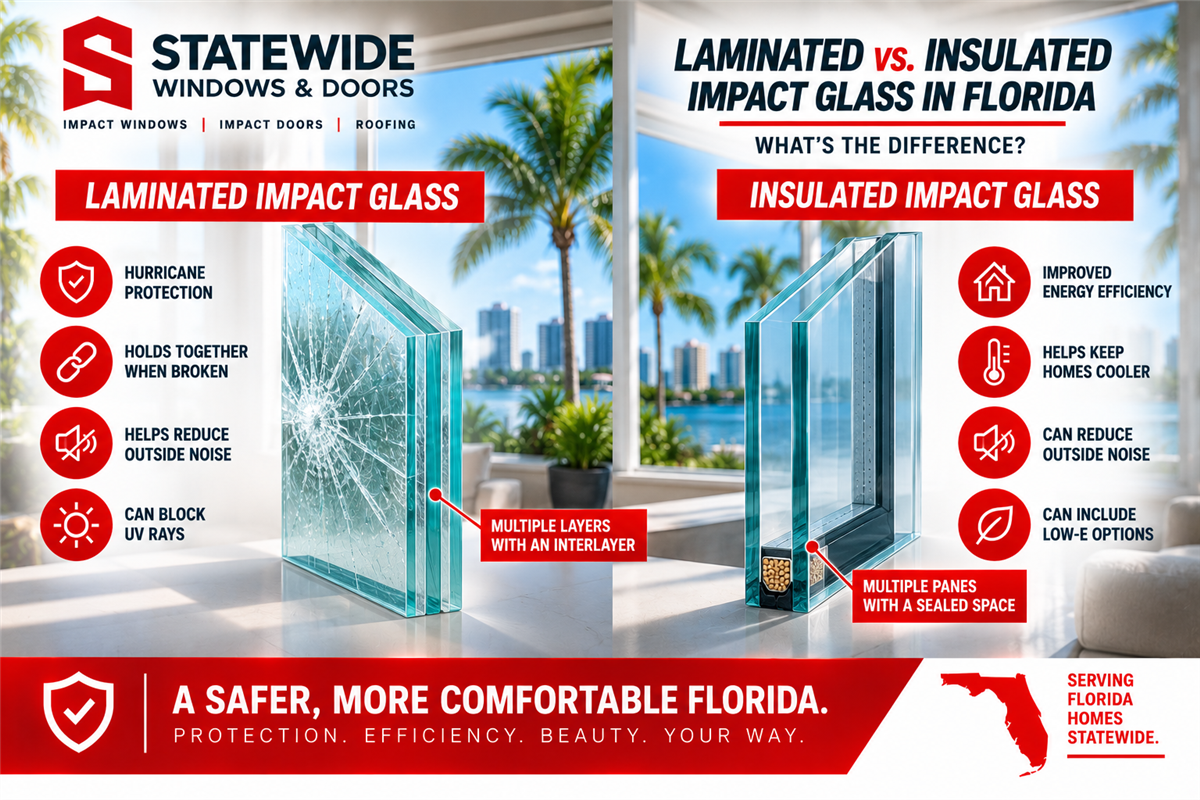
Laminated glass is constructed using multiple layers of glass with an interlayer bonded between them.
If the glass is broken, the interlayer is designed to help hold broken glass fragments together rather than allowing the entire glazed area to immediately separate into loose pieces.
Laminated glazing is an important component of many impact-resistant window and door systems.
However, homeowners should remember that hurricane protection depends on the complete approved window or door system, not the glass alone.
The complete system can include:
- Laminated glazing
- Frame
- Glazing components
- Hardware
- Anchoring
- Installation method
What Is Insulated Glass?
An insulated glass unit generally contains multiple panes of glass separated by a sealed space.
This configuration is designed primarily to improve thermal performance compared with certain single-glazed configurations.
Depending on the product, the glass unit may also incorporate other features such as Low-E coatings.
Insulated glass should not automatically be confused with impact-resistant glass.
A multi-pane insulated window is not necessarily an impact window.
What Is Insulated Impact Glass?
An insulated impact glass configuration combines insulating characteristics with impact-resistant glazing within the applicable window system.
Depending on the product design, an insulated impact unit may include a laminated component along with another pane of glass and a sealed space between them.
The exact construction varies by manufacturer and product.
That is why homeowners should ask for information about the specific glass package rather than assuming all insulated impact windows are constructed identically.
Laminated vs. Insulated Impact Glass: The Main Difference
The easiest way to understand the distinction is to separate impact performance from thermal performance.
Laminated glazing is commonly used as part of an impact-resistant system because the bonded construction helps the glazing remain together after breakage.
Insulated glass is primarily designed to improve the thermal characteristics of the glazing system by using multiple panes separated by a sealed space.
An impact window can potentially combine both concepts.
So homeowners should not think of laminated and insulated glass as two completely opposite choices.
In some products, insulated impact glazing incorporates laminated glass as part of the overall glass unit.
Does Double-Pane Mean Impact-Resistant?
No.
This is one of the most important distinctions Florida homeowners should understand.
A window having two panes of glass does not automatically mean it is impact-resistant.
Double-pane construction generally describes the number or arrangement of glass panes within an insulated glass unit.
Impact resistance depends on the complete tested and approved product configuration.
Homeowners should never assume that "double-pane" and "hurricane impact" mean the same thing.
Does Laminated Glass Mean the Entire Window Is Impact-Rated?
Not necessarily.
Laminated glass is an important component of many impact-resistant products, but a piece of laminated glass by itself does not establish that an entire window system is approved for a particular hurricane application.
The frame, glazing method, anchoring, dimensions, hardware where applicable, and other components all work together as a complete system.
When reviewing a quote, ask about the exact window product and its applicable approval rather than focusing only on the word "laminated."
What Happens When Laminated Impact Glass Breaks?
Impact-resistant does not mean unbreakable.
Under sufficient force, the glass can crack or break.
The laminated construction is designed so the interlayer can help keep broken glass bonded together.
This is an important distinction from ordinary glass that may break apart differently.
The goal of an impact-resistant system is not to guarantee that the glass will never crack. It is to perform according to the requirements applicable to the tested and approved system.
Impact Windows Are Not “Hurricane-Proof”
Homeowners may encounter marketing language describing certain windows as "hurricane-proof."
A more accurate term is impact-resistant.
Impact-resistant products are designed and tested for specified conditions, but no responsible contractor should promise that a window can never be damaged during an extreme storm.
Understanding this distinction helps homeowners evaluate window claims more realistically.
Which Option Is Better for Energy Efficiency?
Insulated glass configurations are often considered when energy performance is an important priority.
The additional pane and sealed space can contribute to the thermal performance of the complete window.
However, homeowners should compare documented performance information rather than relying only on the term "insulated."
Important measurements and features can include:
- U-factor
- Solar Heat Gain Coefficient
- Low-E coatings
- Glass configuration
- Frame design
- Window orientation
- Installation
The complete window determines performance—not one glass feature by itself.
Why Energy Performance Matters in Florida
Florida homes can experience intense solar exposure and long periods of air-conditioning use.
Windows can influence how much solar heat enters the home, particularly in areas receiving substantial direct sunlight.
When comparing glass packages, homeowners should ask how the proposed window addresses the conditions relevant to their property.
A more expensive glass package is not automatically necessary for every opening, but understanding the available energy-performance options can help homeowners make a more informed decision.
What Is Low-E Glass?
Low-E, or low-emissivity, glass uses a coating designed to influence the way heat energy passes through the glazing.
Low-E technology can be incorporated into certain window glass packages to improve thermal or solar performance.
However, Low-E is not the same thing as impact resistance.
A window can have Low-E glass without being an impact window.
An impact window can also incorporate Low-E features when the applicable product configuration offers them.
Can Laminated Impact Glass Have Low-E?
Depending on the manufacturer and product configuration, Low-E options may be available with laminated impact glazing.
Homeowners should verify the exact glass package available for the window they are considering.
Do not assume that every impact product automatically includes the same Low-E coating or energy-performance characteristics.
Can Insulated Impact Glass Have Low-E?
Yes, Low-E configurations may be available with certain insulated impact glass systems.
This combination can allow a window to address impact resistance while also incorporating features intended to improve thermal or solar performance.
The specific configuration should be confirmed with the contractor and manufacturer documentation.
Understanding U-Factor
U-factor is a measure related to heat transfer through a window assembly.
Generally, homeowners can use U-factor as one piece of information when comparing the thermal performance of window products.
It should be evaluated together with other characteristics rather than used as the only measure of window quality.
When comparing two impact windows, make sure you are comparing the actual documented ratings for the proposed products and glass configurations.
Understanding Solar Heat Gain Coefficient
Solar Heat Gain Coefficient, often abbreviated as SHGC, relates to how much solar radiation passes through a window.
This can be particularly relevant in Florida because of the state's strong sunlight.
Homeowners comparing glass packages should ask about the SHGC of the specific window rather than assuming every Low-E or insulated glass product performs the same way.
Does Insulated Impact Glass Keep a Home Cooler?
An energy-efficient window configuration can help influence heat transfer and solar heat gain, but homeowners should avoid interpreting this as a guarantee that one glass package will produce a specific indoor temperature or utility-bill reduction.
Whole-home energy performance depends on many factors, including:
- Roof and attic insulation
- HVAC system
- Home orientation
- Window area
- Air leakage
- Doors
- Wall construction
- Homeowner behavior
Windows are one part of the home's overall building envelope.
Which Glass Is Better for Noise Reduction?
Laminated glazing can contribute to reducing certain exterior sounds compared with some standard glass configurations.
Insulated glass construction can also influence acoustic performance.
However, noise reduction depends on the specific glass makeup and complete window assembly.
Homeowners should not assume that every insulated impact window will automatically provide more noise reduction than every laminated configuration.
If noise is a major concern, ask about the specific product's available acoustic performance information.
Impact Windows Do Not Make a Home Soundproof
Even high-quality impact windows should not be marketed as making a home completely soundproof.
Exterior noise can also enter through:
- Doors
- Walls
- Roof assemblies
- Vents
- Other openings
Impact-resistant laminated glazing may noticeably reduce certain sounds, but the result depends on the entire building envelope.
Which Glass Option Is Thicker?
Glass thickness depends on the exact configuration.
An insulated impact unit can contain multiple glass components and a sealed space, so its overall construction can differ substantially from a simpler laminated configuration.
However, homeowners should not choose glass based on thickness alone.
A thicker glass unit is not automatically a better product for every application.
The relevant question is whether the complete window configuration provides the performance required for the project.
Does Thicker Glass Mean Better Hurricane Protection?
Not automatically.
Hurricane protection cannot be determined by looking at glass thickness alone.
The complete system matters, including:
- Glass construction
- Interlayer
- Frame
- Glazing method
- Window dimensions
- Anchoring
- Design pressure
- Applicable product approval
Homeowners should avoid choosing between products based only on which glass sounds thicker or heavier.
Does Impact Glass Block UV Rays?
Different laminated and coated glass configurations can reduce portions of ultraviolet transmission, but the amount varies by product.
Homeowners concerned about fading of flooring, furniture, artwork, or interior finishes should ask for the documented performance of the exact glass package.
Do not assume every impact window blocks the same percentage of ultraviolet radiation.
Laminated vs. Insulated Impact Glass for Waterfront Homes
Waterfront Florida homes can have significant exposure to sunlight, wind, humidity, and salt air.
The glass package is only one part of choosing an appropriate window system for these properties.
Homeowners should also consider:
- Frame material
- Frame finish
- Hardware
- Design pressure
- Product approval
- Installation
- Coastal maintenance requirements
If the home has large waterfront views, energy performance may become especially important because of the amount of glass exposed to sunlight.
What About Large Picture Impact Windows?
Large picture windows can create beautiful views and bring substantial natural light into a home.
They can also contain a large amount of glass exposed to Florida sunlight.
When selecting glass for a large fixed opening, homeowners should discuss:
- Impact requirements
- Design pressure
- Available glass configurations
- Low-E options
- U-factor
- Solar Heat Gain Coefficient
- Visible light
The best configuration depends on the actual product and opening.
Does Window Frame Material Affect the Glass Choice?
The frame and glazing work together as part of the complete window system.
Statewide Windows & Doors offers both aluminum and vinyl impact window options depending on the project.
Available glass packages can vary between manufacturers, frame systems, window styles, sizes, and product series.
Homeowners should therefore compare complete window configurations rather than choosing the frame and glass independently without confirming compatibility.
What Glass Is Used in Sliding Impact Doors?
Impact-resistant sliding glass doors also rely on approved glazing configurations.
Because sliding doors can involve large glass panels, homeowners may encounter several glass and energy-performance options depending on the product.
When comparing sliding glass doors, ask about:
- Impact glazing configuration
- Insulated glass options
- Low-E options
- Energy-performance information
- Panel dimensions
- Design pressure
- Applicable product approval
Explore sliding glass door options from Statewide Windows & Doors.
Laminated vs. Insulated Impact Glass in Miami-Dade and Broward County
Miami-Dade and Broward County are located within Florida's High-Velocity Hurricane Zone.
Homeowners in these counties should not choose a window based solely on whether the glass is laminated or insulated.
The exact window product, dimensions, glazing configuration, and installation need to be appropriate for the intended HVHZ application.
A Miami-Dade Notice of Acceptance is one recognized approval pathway, while qualifying Florida Product Approvals specifically approved for HVHZ use can also apply.
The important question is whether the specific product and configuration are approved for the intended application.
Statewide Windows & Doors has completed thousands of projects across Miami-Dade and Broward County and has substantial experience working with impact window and door projects in these markets.
Product Approval Applies to the Complete Configuration
Homeowners should not separate the glass from the rest of the product when reviewing approval information.
The applicable product documentation can identify specific configurations involving:
- Window type
- Dimensions
- Glass construction
- Frame
- Design-pressure information
- Installation requirements
- Conditions or limitations of use
Changing the glass configuration can potentially mean you are looking at a different approved configuration.
For more information, read our guide to Miami-Dade NOA vs. Florida Product Approval.
Which Glass Option Costs More?
Insulated impact glass configurations may involve additional materials and manufacturing compared with certain other glass packages, but there is no universal price difference that applies to every product.
Window cost can depend on:
- Manufacturer
- Product series
- Window style
- Window dimensions
- Frame material
- Glass configuration
- Low-E options
- Hardware
- Installation conditions
- Overall project scope
The most useful comparison is the total installed cost of the specific products being considered.
Is Insulated Impact Glass Worth the Additional Cost?
It can be for some homeowners, but the answer depends on the property and priorities.
Insulated impact glass may deserve consideration when homeowners place a high priority on energy performance or when the proposed configuration offers other characteristics they value.
However, homeowners should compare the documented performance improvement and price difference rather than automatically assuming the most expensive glass package is necessary.
Which Glass Is Best for a Florida Home?
There is no single glass package that is automatically best for every Florida property.
The right option can depend on:
- Location
- Window orientation
- Opening dimensions
- Window style
- Energy-efficiency goals
- Noise concerns
- Budget
- Applicable product requirements
- HVHZ requirements where applicable
A homeowner with large west-facing windows may prioritize different characteristics from a homeowner replacing smaller shaded openings.
Questions to Ask When Comparing Impact Glass
Before choosing a glass package, ask your contractor:
- Is this laminated impact glass or insulated impact glass?
- What exactly is included in the glass configuration?
- Is this complete window impact-resistant?
- What product approval applies?
- Is this exact configuration appropriate for my location?
- What is the U-factor?
- What is the Solar Heat Gain Coefficient?
- Does the glass include Low-E technology?
- What energy-performance differences exist between the options?
- Are there different tint or appearance options?
- How does the glass affect the warranty?
- What is the price difference?
- What benefits am I receiving for the additional cost?
These questions make it easier to compare quotes based on actual product characteristics rather than marketing terminology.
Common Myths About Impact Glass
"Double-Pane Means Impact-Resistant"
False. Multiple panes alone do not establish impact resistance.
"Impact Glass Cannot Break"
False. Impact-resistant glass can crack or break under sufficient force.
"Low-E Means Impact Glass"
False. Low-E relates to thermal and solar performance, not hurricane impact resistance.
"The Thickest Glass Is Always the Strongest"
Not necessarily. The performance of the complete approved system matters more than glass thickness alone.
"Every Impact Window Has the Same Glass"
False. Glass configurations can vary by manufacturer, product, size, window style, and available options.
"Insulated Impact Glass Is Always the Best Choice"
Not necessarily. The best configuration depends on the home, opening, climate exposure, performance goals, and budget.
Laminated or Insulated Impact Glass: Which Should You Choose?
Homeowners should begin by making sure the proposed window provides the required impact-resistant performance for its intended application.
From there, compare the additional characteristics that matter to your home.
A laminated impact configuration may meet the homeowner's priorities when hurricane protection and the features of that particular product are the primary goals.
An insulated impact configuration may be worth considering when the homeowner also wants additional thermal-performance features available with that product.
The choice should be based on documented product information rather than assuming one glass type is universally superior.
How Statewide Windows & Doors Helps Homeowners Compare Glass Options
At Statewide Windows & Doors, homeowners can evaluate impact window and door options based on the needs of their actual property.
Depending on the project and available products, our team can help homeowners compare:
- Impact-resistant glazing
- Laminated glass configurations
- Available insulated glass configurations
- Low-E options
- Aluminum and vinyl frames
- Window styles
- Energy-performance information
- Design-pressure considerations
- Applicable product documentation
- Permitting and installation requirements
Statewide has more than 25 years of combined industry experience and has completed thousands of projects across Miami-Dade and Broward County while serving homeowners throughout Florida.
Explore our impact window options, impact doors, completed projects, and Florida service areas.
Why Choose Statewide Windows & Doors?
Choosing impact windows involves more than selecting a frame or deciding whether a window is advertised as hurricane-resistant.
The glass configuration, frame, window style, product approval, design pressure, energy-performance options, permitting, installation, warranty, and service should all be considered together.
Statewide Windows & Doors helps Florida homeowners understand these options so they can compare products based on the characteristics that matter to their property.
Our team also works across project management, permitting coordination, installation, inspections, and customer service to help manage the complete replacement process.
Final Words
Laminated and insulated impact glass are not simply two competing versions of the same thing.
Laminated glazing is commonly used as part of impact-resistant systems, while insulated glass construction is primarily associated with thermal performance. Certain impact window products can combine both.
When comparing options, homeowners should look beyond labels such as "double-pane," "Low-E," or "impact glass."
Ask about the exact glass construction, complete window system, applicable product approval, energy-performance information, design pressure, warranty, and installed price.
The best glass package for a Florida home is the one that provides the appropriate impact protection while also matching the homeowner's energy, comfort, appearance, and budget priorities.
Tags
Subscribe to Statewide Windows & Doors's Blog



Comments