 Free Estimate
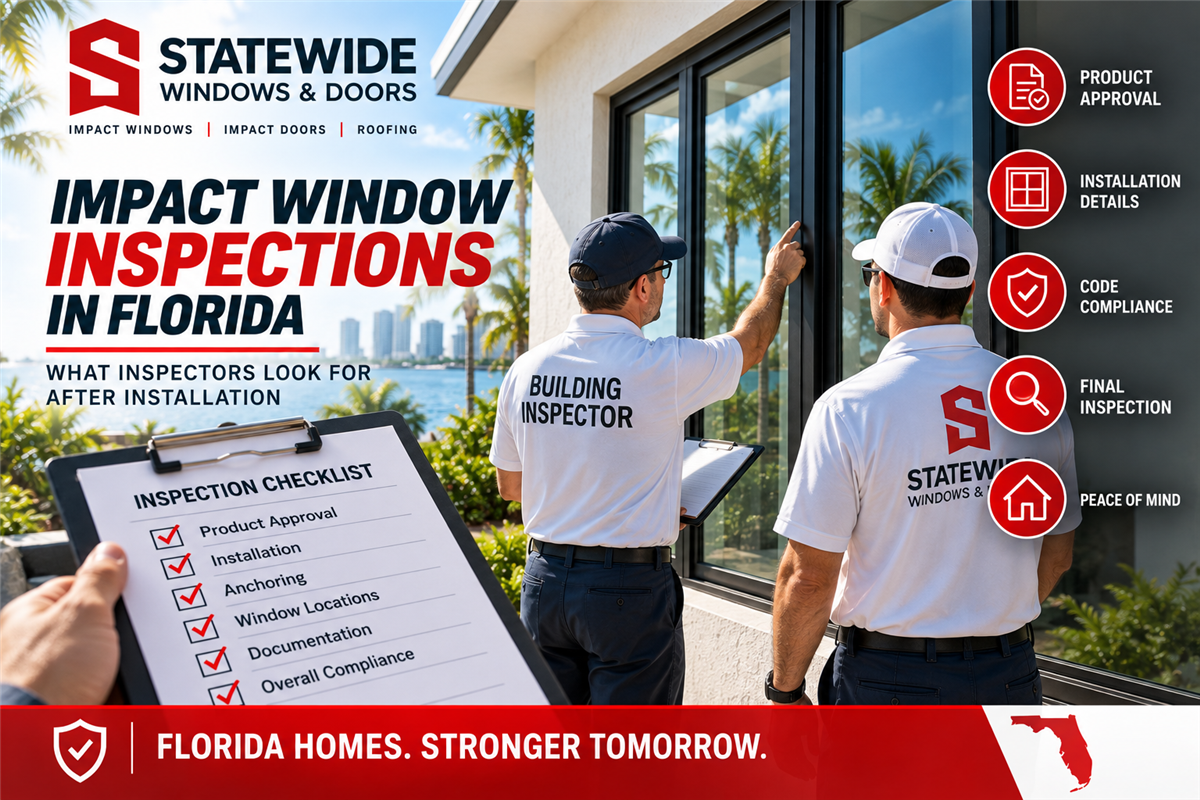
Installing impact windows is a major milestone in a Florida window replacement project, but installation day may not be the final step.
When a project requires a building permit, an inspection may be required before the permitted work can be finalized.
For homeowners, this can raise several questions: What does the inspector actually look at? Does the inspector test the glass? What happens if something needs to be corrected? And when is the permit officially complete?
Understanding the inspection process can help homeowners know what to expect after their impact windows and doors are installed.
Here is what Florida homeowners should know about impact window inspections.
Why Are Impact Window Inspections Required?
A building inspection is part of the permitting process for applicable window and door replacement projects.
The purpose is not simply to determine whether the new windows look good.
The inspection helps confirm that the permitted work corresponds with applicable requirements and the approved project documentation.
Because permitting and inspection procedures can vary by jurisdiction and project, homeowners should not assume that every city or county in Florida follows an identical process.
When Does the Inspection Happen?
The timing depends on the project and the requirements of the applicable building department.
Generally, the inspection process occurs after the relevant installation work has reached the stage required for inspection.
Your contractor should understand when the inspection needs to be requested and what portions of the installation need to remain available for inspection.
This is one reason homeowners should avoid altering or covering completed work before required inspections have occurred.
Who Schedules the Impact Window Inspection?
For contractor-managed projects, inspection coordination is commonly part of the contractor's permitting and project-management responsibilities.
However, homeowners should confirm this before signing a contract.
Ask:
- Who schedules the inspection?
- Does someone need to be home?
- Who communicates the inspection date?
- Who handles questions from the building department?
- Who handles corrections if something is identified?
- Who confirms that the permit has been finalized?
Clear responsibility can make the final stages of the project easier to manage.
What Does an Impact Window Inspector Look For?
The exact inspection depends on the jurisdiction, permit, project, and products installed.
There is not one universal checklist that applies to every Florida impact window installation.
However, an inspection can involve verifying that the installed work corresponds with the permitted project and applicable installation requirements.
Areas relevant to the inspection may include:
- The windows and doors installed
- Product identification
- Opening locations
- Installation details
- Fastening or anchoring
- Applicable product approval information
- Required documentation
- Other project-specific requirements
The inspector's role is not to select products for the homeowner or replace the contractor's responsibility for proper installation.
1. The Installed Product
One important consideration is whether the product installed corresponds with the permitted project documentation.
This is why contractors need to carefully coordinate product selection before installation.
A permit may contain information identifying the windows or doors intended for particular openings.
If a different product or configuration is installed, additional review or documentation may potentially be required depending on the circumstances and jurisdiction.
2. Product Approval Information
Florida homeowners frequently encounter terms such as Florida Product Approval and Miami-Dade Notice of Acceptance when researching impact windows.
These approvals are important because the specific product and configuration must be suitable for its intended application.
For homes within the High-Velocity Hurricane Zone, additional attention must be given to whether the applicable product configuration is approved for HVHZ use.
Miami-Dade and Broward County are both located within Florida's HVHZ.
A Miami-Dade NOA is one recognized pathway. Qualifying Florida Product Approvals specifically approved for HVHZ applications can also apply.
The important question is not simply whether a window has a Florida approval number.
The question is whether the specific product and configuration are approved for the intended application.
For a deeper explanation, read our guide to Miami-Dade NOA vs. Florida Product Approval.
3. Window and Door Locations
The permitted documents may identify where particular windows and doors are being replaced.
The completed installation should correspond with the approved project scope.
This is one reason accurate measurements, window schedules, and product coordination matter before installation begins.
A project involving ten windows should not be treated as ten interchangeable openings if different locations require different sizes or configurations.
4. Fastening and Anchoring
How a window or door is secured is an important part of an impact-resistant installation.
However, there is no single universal anchor pattern that applies to every impact window.
Fastening requirements can depend on factors such as:
- The specific product
- Product configuration
- Opening size
- Building construction
- Substrate
- Applicable approval documentation
- Project requirements
The installation should follow the applicable requirements for the specific approved system.
This is why homeowners should be cautious of simplified claims that every impact window is installed exactly the same way.
5. Installation Details
An impact window is more than a piece of impact-resistant glass.
The complete installed system includes the frame, attachment to the structure, and other applicable installation components.
An inspection may involve installation details relevant to the permitted work.
Professional installation therefore matters even when homeowners purchase high-quality impact-resistant products.
6. Documentation
Documentation can be an important part of the inspection and permit process.
Depending on the jurisdiction and project, the contractor may need to maintain or provide information associated with:
- Product approvals
- Window and door schedules
- Permit documents
- Product information
- Installation information
- Other required project records
Experienced permitting and project-management teams can help keep these pieces coordinated throughout the project.
Does the Inspector Test the Impact Glass?
Homeowners sometimes imagine that a building inspector physically tests the impact resistance of newly installed glass at their home.
That is not how product impact testing works.
Impact-resistant window and door systems undergo applicable testing as part of their product approval process.
The building inspection focuses on the permitted installation rather than recreating laboratory impact testing at the homeowner's property.
An inspector is not going to strike your new window with debris to determine whether it is impact-resistant.
Does Passing Inspection Mean a Window Is Hurricane-Proof?
No window should be described as completely hurricane-proof.
Impact-resistant windows and doors are designed and tested to meet specified performance requirements, but that does not make them indestructible.
Passing a building inspection also should not be interpreted as a guarantee that a product can never experience damage during severe weather.
The more accurate description is impact-resistant.
Does the Inspector Check Every Window?
The exact inspection procedure is determined by the applicable building authority and the specific project.
Homeowners should not assume that every jurisdiction, inspector, or project follows an identical inspection method.
If you have questions about how an inspection will be performed for your project, ask your contractor or the applicable building department.
What Happens If an Impact Window Installation Fails Inspection?
A failed inspection can sound alarming, but it does not automatically mean all of the windows need to be removed or that the entire project has failed.
An inspector may identify a specific item requiring correction, clarification, or additional documentation.
Depending on the issue, the contractor may need to:
- Correct an installation detail
- Provide additional documentation
- Clarify product information
- Address another inspection comment
- Schedule a follow-up inspection
The appropriate response depends on what the inspector identifies.
Who Is Responsible for Correcting an Inspection Issue?
Before hiring a contractor, homeowners should understand who manages inspection-related corrections.
For a professionally managed project, the contractor should have a process for responding to legitimate issues involving its permitted work.
Ask this question before signing:
"If the inspector identifies something that needs to be corrected, who handles it and coordinates the reinspection?"
The answer can tell you a great deal about the company's project-management structure.
What Is a Reinspection?
If an item must be corrected after an inspection, another inspection may be required before the applicable work can receive final approval.
The contractor should address the required issue and coordinate the next step according to the jurisdiction's procedures.
Homeowners should not assume that correcting the physical item alone automatically closes the permit.
The required inspection process must still be completed.
What Happens After the Final Inspection?
After required inspections are successfully completed, the permit should proceed toward the appropriate final or closed status according to the jurisdiction's process.
This administrative step is important.
A physically completed installation and a properly finalized permit are related but not identical concepts.
Homeowners should confirm that the applicable permit has reached its proper final status.
Why Permit Closeout Matters
Permit closeout helps establish that the permitted project moved through the required process.
Keeping the final permit information with your home records can also be useful in the future.
Depending on the circumstances, project records may be relevant when:
- Selling the home
- Researching previous improvements
- Requesting future service
- Reviewing warranty information
- Planning additional renovations
Keep important project documents rather than discarding everything once installation is finished.
Impact Window Inspections in Miami-Dade County
Impact window projects in Miami-Dade County deserve particular attention because the county is within Florida's High-Velocity Hurricane Zone.
Contractors working in Miami-Dade should understand the applicable requirements involving product documentation, permitting, installation, and inspections.
Homeowners should make sure the specific products and configurations being proposed are appropriate for the property's application.
Statewide Windows & Doors installs impact windows and doors throughout Miami-Dade County and has substantial completed-project experience in the area.
Impact Window Inspections in Broward County
Broward County is also within the High-Velocity Hurricane Zone.
However, homeowners should not assume that every property in Broward uses one identical permitting process.
Different municipalities and authorities having jurisdiction can have their own administrative procedures.
A contractor's familiarity with Florida permitting should therefore extend beyond simply knowing that a permit is required.
The company should be prepared to determine and follow the process applicable to the specific property.
Why Local Permitting Experience Matters
This is one area where actual project experience can matter more than the location of a contractor's headquarters.
A contractor may be headquartered nearby but have limited experience with your type of project.
Another company may serve a larger portion of Florida while having substantial experience completing projects in your specific market.
The better question is whether the contractor has experience successfully completing your type of project in the area where you live.
Statewide Windows & Doors has completed thousands of projects across Miami-Dade and Broward County while also serving homeowners in other areas of Florida.
Inspection vs. Manufacturer Warranty
A passed building inspection and a manufacturer warranty serve different purposes.
An inspection relates to the permitted construction work.
A manufacturer's warranty addresses specified product coverage according to the manufacturer's written terms.
One does not replace the other.
Likewise, a contractor's workmanship warranty may be separate from both the manufacturer's warranty and the building inspection.
Homeowners should understand all three independently.
Inspection vs. HOA Approval
HOA or condominium approval is also separate from a building inspection.
An association may have architectural requirements involving:
- Frame colors
- Window appearance
- Glass appearance
- Door styles
- Project documentation
Receiving association approval does not replace a required building permit or inspection.
Likewise, passing a building inspection does not necessarily resolve a separate association requirement.
Can Homeowners Check Their Permit Status?
Many Florida jurisdictions provide online systems that allow property owners to research permit information.
The exact system and information available depend on the jurisdiction.
Homeowners can ask their contractor for the permit number and applicable building department so they understand where their project is in the process.
Transparency about permit status is an important part of project communication.
Questions to Ask Before Your Impact Window Inspection
Before the inspection stage, consider asking your contractor:
- Has my installation been completed to the stage required for inspection?
- Who schedules the inspection?
- When is the inspection expected?
- Does someone need to be home?
- What documentation is required?
- Who communicates with the inspector?
- What happens if a correction is required?
- Who schedules a reinspection if necessary?
- How will I know when the permit is finalized?
A contractor should be able to explain how the final stages of the project are managed.
What Homeowners Should Keep After Inspection
Once the project is completed, keep relevant documentation together.
Depending on the project, your records may include:
- Signed contract
- Final proposal
- Product information
- Manufacturer warranty documents
- Workmanship warranty information
- Permit information
- Inspection records
- Product approval documentation
- Service records
These records provide a useful history of the improvements completed on the property.
How Statewide Windows & Doors Handles the Project Beyond Installation Day
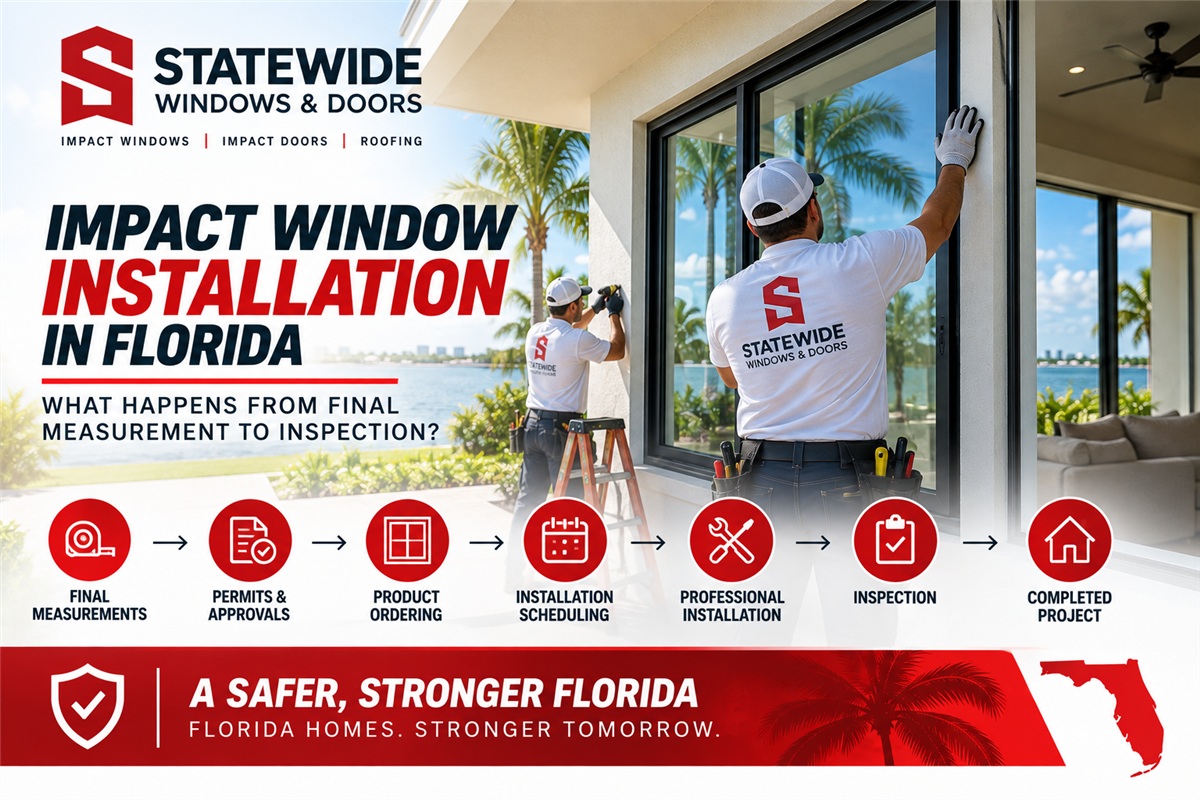
At Statewide Windows & Doors, an impact window project involves more than delivering and installing windows.
Depending on the project, our team coordinates multiple stages that can include:
- Final measurements
- Product configurations
- Applicable documentation
- HOA coordination
- Permitting
- Installation
- Inspection coordination
- Project management
- Customer service
Statewide has more than 25 years of combined industry experience and has completed thousands of projects across Miami-Dade and Broward County.
Homeowners can explore our impact windows, impact doors, past projects, and Florida service areas.
Why Choose Statewide Windows & Doors?
A successful impact window project involves much more than choosing the glass and frame.
Measurements, product selection, permitting, installation, inspections, project management, and service all contribute to the homeowner experience.
Statewide Windows & Doors has teams involved across these different stages to help move projects from the initial consultation through installation and the applicable final project requirements.
If you are considering impact windows or doors for your Florida home, Statewide can help you understand the products and process involved in your project.
Final Words
An impact window inspection is an important final stage of many permitted Florida window replacement projects.
The inspection is not a hurricane simulation and does not involve physically impact-testing your new glass at your home.
Instead, the applicable building authority reviews the permitted work according to the requirements relevant to the project.
If a correction is identified, the contractor should address the applicable issue and coordinate the required next steps.
Once required inspections are successfully completed, homeowners should also make sure the permit reaches its appropriate final status.
Understanding this process before installation can help you know what to expect and choose an impact window contractor that is prepared to manage the project beyond installation day.
Tags
Subscribe to Statewide Windows & Doors's Blog




Comments