 Free Estimate
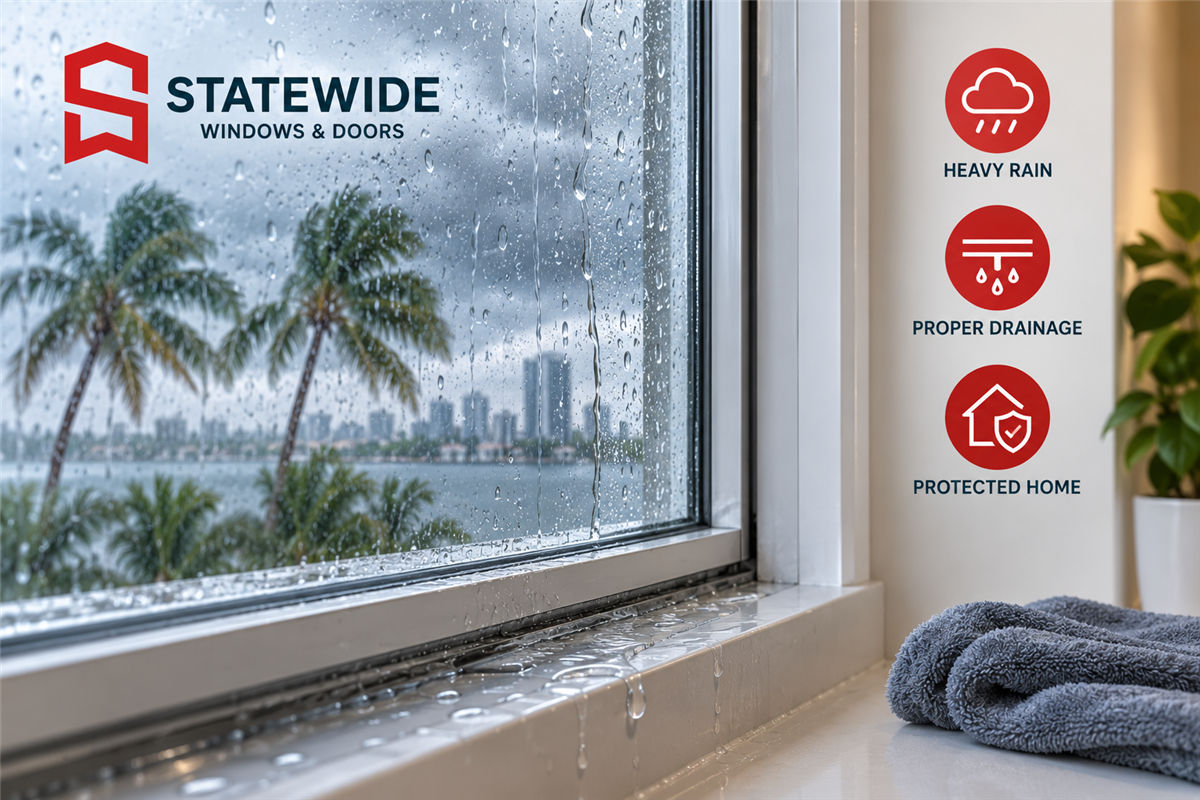
Impact windows are designed to help protect Florida homes from windborne debris and severe weather, but homeowners may still become concerned if they notice water around a window during or after heavy rain.
A small amount of visible water does not always mean the impact window itself has failed.
Water can appear around a window for several different reasons, including condensation, drainage-system behavior, clogged drainage paths, deteriorated sealant, installation conditions, surrounding building-envelope issues, or actual water intrusion.
The location of the water, when it appears, and the conditions outside can provide important clues.
Florida homeowners should also understand that impact-resistant does not mean completely waterproof under every possible condition.
Here is what homeowners should know when they notice water around an impact window.
Can Impact Windows Leak Water?
Impact windows are designed as complete systems with specific performance characteristics, but no responsible contractor should describe every impact window as incapable of allowing water under every possible condition.
Water performance can depend on factors such as:
- The specific window product
- Window style
- Installation
- Sealants and flashing where applicable
- Drainage features
- Wind-driven rain
- Building conditions around the opening
- Maintenance
- Storm intensity and exposure
If water is entering the interior of the home, the source should be evaluated rather than assuming the glass itself is responsible.
Impact-Resistant Does Not Mean Waterproof
The term impact-resistant primarily describes the window system's ability to meet applicable impact-related testing and approval requirements.
Water resistance is another aspect of window performance.
A window may have characteristics related to:
- Impact resistance
- Design pressure
- Air infiltration
- Water penetration resistance
- Energy performance
These characteristics should not be treated as if they all mean exactly the same thing.
First Determine Where the Water Is Coming From
Before assuming the impact window is leaking, homeowners should carefully observe where the moisture appears.
Water may be:
- On the interior glass surface
- On the exterior glass surface
- Inside a window track
- Around the bottom of the frame
- Between panes of insulated glass
- Coming from the wall above the window
- Appearing around the sides of the opening
- Entering beneath the sill
These conditions can have very different causes.
Condensation vs. Water Intrusion
Condensation and rainwater intrusion are not the same thing.
Condensation forms when moisture in the air encounters a surface temperature that allows water vapor to become liquid droplets.
Water intrusion involves water entering through or around part of the building envelope.
If moisture appears on the glass even when it is not raining, condensation may be one possibility.
If water consistently appears during wind-driven rain, the window, installation, drainage system, or surrounding construction may need evaluation.
Is Water in an Impact Window Track Normal?
Some window systems are designed with drainage features that help manage water entering portions of the exterior track or frame.
Depending on the product, water may be directed toward drainage openings that allow it to return to the exterior.
Therefore, seeing some water within an exterior drainage area does not automatically mean the window has failed.
However, water overflowing into the interior, remaining where it should not, or repeatedly causing damage should be evaluated.
What Are Weep Holes?
Many window systems include drainage openings commonly referred to as weep holes.
These openings can allow water within designated portions of the window system to drain toward the exterior.
The exact drainage design varies by manufacturer and window style.
Homeowners should not drill new holes into an impact window or modify existing drainage features without manufacturer guidance.
Can Clogged Weep Holes Cause Water Problems?
Drainage paths can become affected by dirt, debris, insects, landscaping material, paint, or other obstructions.
If a drainage feature cannot function as designed, water may not move through the system normally.
Homeowners can visually inspect accessible areas and keep them clean according to manufacturer recommendations.
Avoid inserting tools deeply into drainage openings or altering the frame.
Why You Should Never Caulk Over Window Drainage Holes
A homeowner may see a small opening in a window frame and assume it was accidentally left unsealed.
That can be a costly mistake.
If the opening is part of the manufacturer's drainage system, sealing it can interfere with water management.
Before applying caulk to any opening in an impact window frame, determine whether the opening is an intentional part of the product.
Can Old Caulk Cause Water Around an Impact Window?
Sealants can play an important role in certain parts of a window installation.
Over time, exposed sealant may require inspection or maintenance depending on the product, installation, environmental conditions, and manufacturer recommendations.
Visible conditions that may deserve attention include:
- Cracking
- Separation
- Gaps
- Missing sections
- Deterioration
However, homeowners should not simply cover every existing sealant joint with additional caulk without understanding the installation.
Why Adding More Caulk Is Not Always the Solution
When homeowners see water, one of the first reactions is often to apply more caulk.
But water can travel through walls and building components before becoming visible inside the home.
The place where water appears may not be the place where it entered.
Applying sealant without identifying the source can temporarily hide symptoms or potentially interfere with drainage.
Proper diagnosis should come before repair.
Can Installation Cause Water Intrusion?
Proper installation is an important part of the complete performance of an impact window.
The window must be installed according to requirements applicable to the specific product and project.
Depending on the opening and construction, important considerations can include:
- Opening preparation
- Window positioning
- Anchoring
- Applicable sealants
- Flashing or water-management details where required
- Exterior finishes
- Integration with surrounding construction
If an installation-related issue is suspected, the window should be professionally evaluated rather than modified without a diagnosis.
Can Water Come From the Wall Instead of the Window?
Yes.
Water can sometimes enter the building envelope at a location above or beside a window and travel before becoming visible near the opening.
Potential sources can involve:
- Roof conditions
- Exterior wall penetrations
- Stucco
- Siding
- Cracks
- Balconies
- Exterior joints
- Other openings
This is why water appearing around a window does not automatically prove the window itself is the entry point.
Why Water Can Travel Before You See It
Buildings contain many connected materials and cavities.
Water entering one location can sometimes move along framing, sheathing, finishes, or other surfaces before becoming visible.
For example, a homeowner may see staining above a window even though the original entry point is located somewhere else.
A proper water-intrusion evaluation should consider the surrounding building envelope rather than focusing only on the visible wet spot.
Why Does My Impact Window Leak Only During Heavy Rain?
A condition that appears only during severe weather may depend on the amount of water, wind direction, pressure, or exposure affecting the opening.
Florida thunderstorms and tropical weather can produce wind-driven rain that behaves differently from ordinary rainfall.
When reporting the problem, homeowners should note:
- How hard it was raining
- Wind direction if known
- Where the water first appeared
- How much water entered
- Whether the problem occurs during light rain
- Whether the same window leaks every time
This information can help with diagnosis.
Why Does My Window Leak Only When the Wind Blows From One Direction?
Wind direction can change how rain interacts with a building.
One elevation may receive much greater wind-driven rain exposure during a particular storm.
This can explain why a problem appears during certain weather events but not others.
Documenting the conditions can help a service professional reproduce or understand the issue.
Can Hurricane-Force Rain Enter Around Windows?
Severe storms can expose windows and doors to demanding combinations of wind and rain.
The performance of a particular product depends on its tested characteristics, dimensions, configuration, installation, and the actual conditions experienced.
Homeowners should avoid assuming that the term "hurricane impact window" means absolutely no water can ever appear during any storm regardless of severity.
What Is Water Penetration Resistance?
Window products can be tested for resistance to water penetration under specified laboratory conditions.
This type of testing is different from impact testing.
When comparing products, homeowners should understand that hurricane protection involves multiple performance considerations rather than one universal rating.
If a specific water-performance rating is important to your project, ask the contractor or manufacturer for documentation for the exact product.
What Does Design Pressure Have to Do With Water?
Design pressure is an important consideration in selecting windows and doors for Florida properties.
It relates to the pressures a product is designed and tested to resist for specified applications.
However, design pressure should not be interpreted as a simple promise that no water can ever enter under any weather condition.
Product selection should consider the complete approved configuration and requirements for the property.
Does a Higher Design Pressure Automatically Mean a Window Will Never Leak?
No.
Homeowners should avoid treating one performance number as a guarantee covering every aspect of a window.
Design pressure, water resistance, impact resistance, installation, and maintenance are related but distinct considerations.
The complete system matters.
Can Impact Window Glass Leak?
Homeowners sometimes describe any water around a window as "the glass leaking."
In many cases, the source may instead involve the frame, glazing system, installation joint, drainage system, or surrounding construction.
If water appears to originate directly around the glazing, the window should be evaluated rather than assuming the exact component responsible.
Does Fog Between the Panes Mean Water Is Leaking Through the Window?
Not necessarily.
Persistent fogging or moisture trapped between panes of an insulated glass unit can indicate a different type of condition than rainwater entering the home.
Between-pane moisture should be evaluated as an insulated-glass issue.
Water appearing on the sill or wall during rainfall should be evaluated as a potential water-management or intrusion issue.
Can Impact Window Seal Failure Cause a Rain Leak?
The phrase "seal failure" can refer to different things, which creates confusion.
An insulated glass edge-seal issue is different from a problem with exterior installation sealants or water management around the window opening.
Homeowners should describe exactly what they see instead of assuming every water problem is caused by the same type of seal.
What About Sliding Glass Doors?
Impact sliding glass doors have large tracks and complex drainage systems compared with many windows.
Depending on the product, portions of the track may be designed to manage water.
Homeowners should distinguish between water within an exterior drainage area and water crossing into the interior living space.
Persistent interior water intrusion should be evaluated.
Explore impact sliding glass door options from Statewide Windows & Doors.
Why Is There Water in My Sliding Glass Door Track?
Seeing water in a sliding door track does not automatically mean the door has failed.
The exact track and drainage design depends on the product.
However, homeowners should pay attention if:
- Water overflows into the home
- Drainage appears blocked
- Water remains for unusually long periods
- Interior flooring becomes wet
- The condition repeatedly worsens
If the normal drainage behavior is unclear, consult the manufacturer or service provider.
Keep Sliding Door Tracks Clean
Large sliding doors can collect dirt, leaves, sand, pet hair, insects, and other debris.
Keeping accessible track areas clean according to manufacturer recommendations can help drainage and operation.
Do not drill additional drainage holes or modify the track without manufacturer guidance.
Can Debris Cause an Impact Window to Hold Water?
Yes, debris can interfere with certain drainage areas.
Florida homes can be exposed to:
- Sand
- Dust
- Leaves
- Mulch
- Insects
- Construction debris
- Salt residue near the coast
Routine cleaning can help prevent accessible drainage areas from becoming obstructed.
Water Problems in Coastal Florida Homes
Coastal homes may experience significant exposure to wind-driven rain, salt, humidity, and severe weather.
Regular maintenance can be particularly important in these environments.
Homeowners should follow manufacturer recommendations regarding:
- Frame cleaning
- Track cleaning
- Hardware maintenance
- Drainage inspection
- Coastal maintenance
- Visible sealant inspection
Can Pressure Washing Cause Window Leaks?
High-pressure water directed at windows, seals, tracks, or joints can create conditions that differ from normal rainfall.
Homeowners should follow manufacturer cleaning recommendations and avoid directing excessively high-pressure water into sensitive window areas.
If water appears only during pressure washing, that does not necessarily mean the window behaves the same way during ordinary weather.
Be Careful When Cleaning Impact Windows
Impact windows should be cleaned in a way that protects finishes, sealants, weatherstripping, drainage features, and hardware.
Avoid:
- Aggressive pressure washing directly into joints
- Sharp tools in drainage openings
- Harsh chemicals not approved for the product
- Painting over drainage areas
- Randomly applying sealant
- Modifying the frame
Follow the manufacturer's maintenance instructions whenever possible.
Can Landscaping Cause Water Problems Around Windows?
Landscaping itself does not necessarily cause a window leak, but exterior conditions around a home can affect drainage and moisture exposure.
Homeowners should avoid allowing soil, mulch, plants, or other materials to block drainage areas around exterior walls and openings.
Sprinklers should also be positioned appropriately so they do not continuously direct water at windows and doors.
Can Sprinklers Make It Look Like a Window Is Leaking?
Yes.
A sprinkler repeatedly spraying directly against a window or surrounding wall can create water exposure that homeowners may mistake for rainfall-related intrusion.
If moisture appears when it has not rained, check irrigation systems and other exterior water sources as part of the investigation.
Why Is My Wall Wet Above the Impact Window?
Moisture appearing above a window may indicate that water is entering somewhere above the visible location.
The source could involve the window opening, but other building-envelope areas should also be considered.
If staining, bubbling paint, soft drywall, or recurring moisture appears around the wall, professional evaluation is recommended.
Why Is My Window Sill Wet?
A wet sill can have several possible causes.
These include:
- Interior condensation
- Water overflowing from a track
- Rainwater intrusion
- Water traveling from another location
- Another moisture source
The timing and location of the moisture are important clues.
Should You Put Towels Around a Leaking Window?
During an active weather event, protecting interior flooring and furnishings from water can be a reasonable temporary step.
However, towels do not address the cause of recurring water intrusion.
Once conditions are safe, document the problem and arrange for appropriate evaluation.
Document the Water Before It Disappears
Water-intrusion problems can be difficult to diagnose after everything has dried.
If it is safe to do so, homeowners should take photos or video showing:
- Where the water first appears
- How it moves
- How much water is present
- The affected window
- The surrounding wall
- The track or sill
- The weather conditions outside
This documentation can be extremely helpful when requesting service.
Do Not Open the Window During Severe Weather to Investigate
Homeowners should prioritize safety during thunderstorms, tropical storms, and hurricanes.
Do not open an impact window or door during dangerous wind and rain simply to determine where water is coming from.
Document what can be safely observed from inside and investigate further after conditions improve.
When Should You Call for Impact Window Service?
Consider requesting professional evaluation if:
- Water repeatedly enters the interior during rain
- Interior flooring or walls become wet
- A window track repeatedly overflows
- Drainage appears blocked
- Visible sealant is damaged
- Staining develops around the opening
- The window does not close or lock correctly
- Water appears around the frame rather than on the glass surface
- You cannot determine where the water is coming from
What Information Should You Send the Service Team?
When requesting service, provide as much useful information as possible.
Include:
- Photos
- Video if available
- Location of the affected window
- Window style
- Where the water appears
- Whether it happens during every rainstorm
- Whether wind direction seems to matter
- Approximate installation date
- Original project information if available
This can help the service team understand the condition before arriving.
Can Water Intrusion Damage the Area Around a Window?
Recurring moisture should not be ignored.
Depending on the materials involved and duration of exposure, repeated water intrusion can affect:
- Drywall
- Paint
- Trim
- Flooring
- Wood components
- Other surrounding materials
Identifying the source early can help prevent a small moisture problem from becoming a larger repair.
Water Intrusion and Impact Windows in Miami-Dade and Broward County
Miami-Dade and Broward County are located within Florida's High-Velocity Hurricane Zone.
Homes in these areas can experience demanding wind and rain conditions, making proper product selection and installation particularly important.
The exact impact window, dimensions, configuration, design pressure, and installation need to be appropriate for the intended application.
A Miami-Dade Notice of Acceptance is one recognized product-approval pathway, while qualifying Florida Product Approvals specifically approved for HVHZ use can also apply.
Generic Florida Product Approval alone should not be assumed to mean that every configuration is approved for every HVHZ application.
The important question is whether the specific product and configuration are approved for the intended use.
Statewide Windows & Doors has completed thousands of projects across Miami-Dade and Broward County and has substantial experience with impact window and door projects in these markets.
Why Proper Permitting and Installation Matter
Florida impact window replacement frequently involves permitting and inspection requirements that vary by jurisdiction and project.
The permitting process helps document the products and installation associated with the project.
Professional installation should follow the applicable requirements for the specific window and opening.
Learn more in our guide to Miami-Dade NOA vs. Florida Product Approval.
Questions to Ask Before Buying Impact Windows
Homeowners concerned about water performance can ask contractors:
- What exact window product are you proposing?
- What product approval applies?
- What design pressure applies to my opening?
- How does this window manage water?
- Where are the drainage openings?
- What maintenance do the tracks require?
- Are there additional coastal maintenance requirements?
- What installation method will be used?
- Who handles service if water intrusion occurs?
- What warranty applies to the product?
- What workmanship warranty applies?
Common Myths About Impact Window Water Leaks
"Impact Windows Can Never Leak"
False. Impact resistance does not mean a window is guaranteed to prevent water under every possible condition.
"Any Water in the Track Means the Window Failed"
Not necessarily. Some systems use tracks and drainage features to manage water.
"Every Small Hole in the Frame Should Be Caulked"
False. Some openings may be intentional drainage features.
"More Caulk Always Fixes a Leak"
False. The source of water should be identified before repairs are made.
"Water Around a Window Always Entered Through the Window"
False. Water can travel through surrounding building components before becoming visible.
"Fog Between Panes and Rainwater Intrusion Are the Same Problem"
False. Between-pane fogging and exterior water intrusion can involve different parts of the window system.
How Statewide Windows & Doors Helps Florida Homeowners
Statewide Windows & Doors works with Florida homeowners throughout the impact window and door replacement process, including product selection, project management, permitting coordination, installation, inspections, and customer service.
Our team helps homeowners understand the products selected for their property and provides support when questions arise after installation.
Statewide has more than 25 years of combined industry experience and has completed thousands of projects across Miami-Dade and Broward County while serving homeowners throughout Florida.
Explore our impact window options, impact doors, customer service information, completed projects, and Florida service areas.
Why Choose Statewide Windows & Doors?
A successful impact window project involves more than selecting impact-resistant glass.
Product selection, design pressure, installation, permitting, drainage, maintenance, warranties, inspections, and post-installation service can all matter throughout the life of the windows.
Statewide Windows & Doors helps Florida homeowners manage the complete replacement process while providing access to customer service after installation.
Final Words
Water around an impact window should be investigated, but it does not automatically mean the window itself has failed.
The first step is determining where the water appears and when it occurs.
Surface condensation, water inside a designed drainage area, clogged drainage openings, deteriorated sealant, surrounding wall conditions, and actual water intrusion can all create different symptoms.
Avoid immediately covering openings with caulk, drilling new drainage holes, or modifying an impact window without understanding how the product is designed.
If water repeatedly enters the interior of your home, document the condition and have the window and surrounding area professionally evaluated.
Proper diagnosis is the key to determining whether the solution involves maintenance, drainage, sealant, window service, installation, or another part of the building envelope.
Tags
Subscribe to Statewide Windows & Doors's Blog








Comments