 Free Estimate
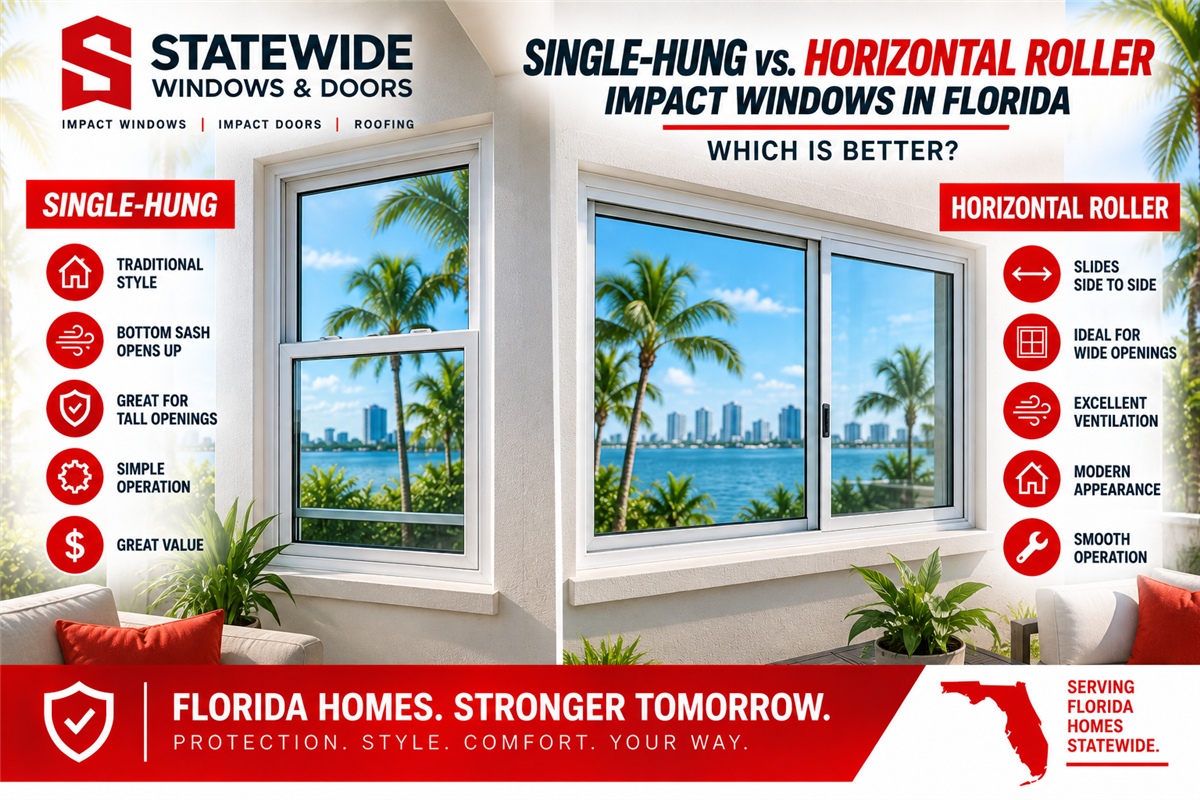
When Florida homeowners start comparing impact windows, choosing the glass and frame material is only part of the decision. The way the window opens can also affect ventilation, appearance, maintenance, operation, and where the window works best in the home.
Two common styles homeowners may encounter are single-hung impact windows and horizontal roller impact windows.
Both can provide impact-resistant protection when the specific product and configuration are approved for the intended application. However, they operate differently and can make sense for different types of openings.
So which one should you choose?
Here is what Florida homeowners should compare before deciding between single-hung and horizontal roller impact windows.
What Is a Single-Hung Impact Window?
A single-hung window has two primary sections, commonly called sashes.
In a typical single-hung configuration, the upper sash remains fixed while the lower sash moves vertically.
To open the window, the homeowner raises the lower portion upward.
When built as part of an approved impact-resistant system, a single-hung window can provide hurricane protection while maintaining a familiar traditional window appearance.
What Is a Horizontal Roller Impact Window?
A horizontal roller window opens from side to side rather than vertically.
Depending on the product configuration, one or more panels may slide horizontally along the window track.
This style is common in Florida homes and can work particularly well for openings that are wider than they are tall.
Like single-hung windows, horizontal rollers can be manufactured as impact-resistant systems when the specific product and configuration meet the applicable requirements.
What Is the Main Difference?
The biggest difference is the direction in which the operable portion of the window moves.
A single-hung window moves vertically.
A horizontal roller moves side to side.
That simple difference can influence:
- Where the window works best
- How the window is operated
- Ventilation
- Appearance
- Opening proportions
- Cleaning and maintenance
Neither operating style is automatically better for every room.
Which Is Better for Hurricane Protection?
Window style alone does not determine hurricane protection.
A qualifying single-hung impact window and a qualifying horizontal roller impact window can both be designed and approved for impact-resistant applications.
Homeowners should focus on the specific product and configuration being proposed.
Important considerations include:
- Impact-resistant glazing
- Frame construction
- Window dimensions
- Applicable product approval
- Design-pressure requirements
- Anchoring
- Installation method
Do not assume one window style provides better hurricane protection simply because of the direction it opens.
Which Window Is Better for Wide Openings?
Horizontal roller windows are commonly considered for openings that are wider than they are tall.
The side-to-side operation works naturally with a horizontal opening.
Depending on the product, horizontal roller configurations can include multiple panels, allowing them to accommodate different opening dimensions.
However, homeowners should still verify the approved sizes available for the specific product being proposed.
Which Window Is Better for Tall Openings?
Single-hung windows often work naturally with openings that are taller than they are wide.
The vertical configuration can complement traditional residential architecture and provides a familiar appearance found throughout Florida.
Again, the exact size limitations depend on the manufacturer and product series.
A contractor should measure the opening and determine which approved configurations are available.
Which Provides Better Ventilation?
Both styles can provide ventilation, but they create openings in different ways.
A single-hung window generally allows ventilation through the lower portion when the operable sash is raised.
A horizontal roller allows ventilation from the side when an operable panel is moved horizontally.
The amount of usable ventilation depends on the window's configuration and dimensions.
Homeowners should consider where they want airflow and how they plan to use the room rather than assuming one style always ventilates better.
Which Is Easier to Open?
Ease of operation can depend on the homeowner, window size, hardware, maintenance, and individual product.
Some homeowners may prefer sliding a horizontal roller from side to side.
Others may prefer raising the lower sash of a single-hung window.
For windows that will be opened frequently, it can be useful to see and operate product samples before choosing a style.
Think About Where the Window Will Be Installed
Window location can influence which operating style feels more practical.
For example, consider a window located:
- Above a kitchen counter
- Near furniture
- In a bedroom
- In a bathroom
- Beside a walkway
- In a living room
The dimensions of the opening and how easily the homeowner can reach the operable portion should be considered.
A window that looks good on paper may not be the most convenient option if it is difficult to operate from its actual location.
Single-Hung Windows in Bedrooms
Single-hung windows are frequently used in bedrooms because of their traditional proportions and straightforward operation.
However, bedroom window replacement can involve more than style preference.
Depending on the property and applicable requirements, opening dimensions and emergency escape and rescue considerations may be relevant.
A homeowner should not change window configurations without making sure the proposed product is appropriate for the opening and applicable project requirements.
Horizontal Roller Windows in Bedrooms
Horizontal rollers may also work well in bedroom openings, particularly where the existing opening is wider.
As with single-hung windows, homeowners should not assume that every roller configuration automatically satisfies every dimensional or code-related consideration.
The specific product, opening, and project requirements should be evaluated before ordering.
Which Style Looks More Modern?
Appearance is subjective.
Horizontal roller windows can complement homes with broad horizontal lines and wider openings.
Single-hung windows can create a more vertical appearance and are often associated with traditional residential architecture.
Either can look contemporary depending on factors such as:
- Frame profile
- Frame color
- Glass appearance
- Window proportions
- Grid patterns
- Home architecture
Homeowners should consider the appearance of the entire elevation rather than selecting each window independently.
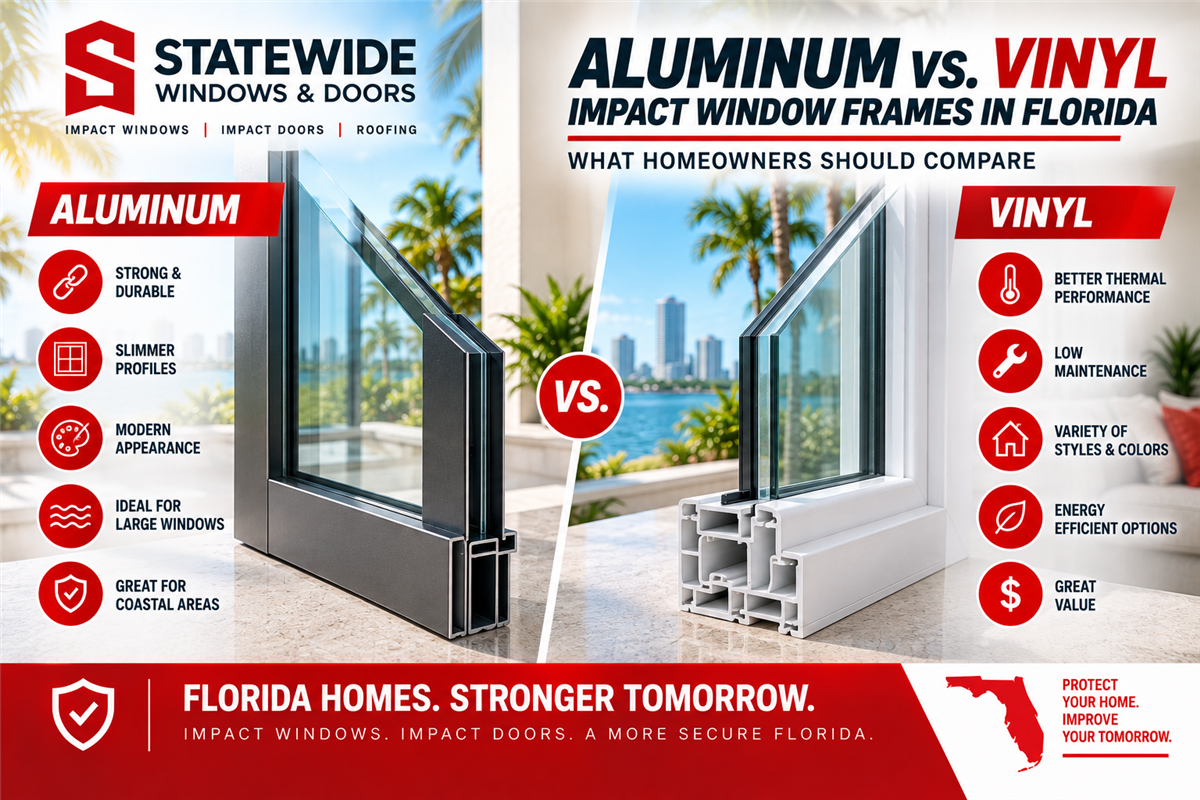
Aluminum or Vinyl Frames?
Window operating style and frame material are separate decisions.
Depending on the available product line, homeowners may encounter single-hung or horizontal roller impact windows using aluminum or vinyl frame systems.
Statewide Windows & Doors offers both aluminum and vinyl impact window options depending on the project.
Frame material can influence factors such as:
- Frame profile
- Thermal characteristics
- Appearance
- Available configurations
- Maintenance considerations
The exact product should be compared rather than assuming one frame material is always better.
Which Style Is More Energy Efficient?
Window style alone does not determine energy efficiency.
The performance of the complete window can depend on:
- Frame design
- Glass configuration
- Low-E coatings
- Insulated glass
- Weatherstripping
- U-factor
- Solar Heat Gain Coefficient
- Installation
When comparing a single-hung window with a horizontal roller, review the documented energy-performance information for the specific products.
Can Both Use Low-E Glass?
Low-E options may be available with different impact window styles depending on the manufacturer and approved product configuration.
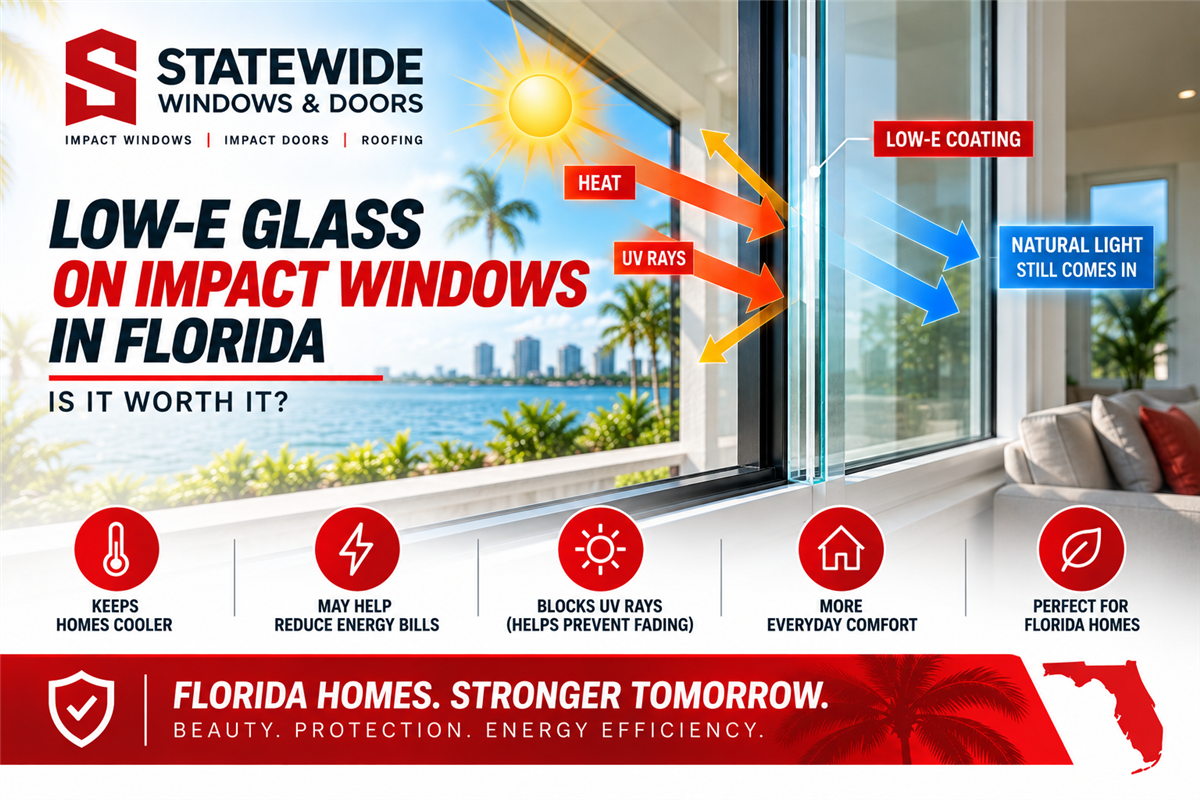
Low-E glass is designed to influence thermal and solar performance.
It should not be confused with impact resistance.
An impact window can combine impact-resistant glazing with Low-E technology when that glass package is available within the applicable product system.
Which Style Is Easier to Clean?
Cleaning considerations vary by product design.
Some windows include features intended to make certain surfaces easier to access, while others may require different cleaning methods.
Homeowners should ask how the specific window operates and how the manufacturer recommends cleaning:
- Glass
- Frames
- Tracks
- Hardware
- Weatherstripping
This is particularly important for upper floors or windows that are difficult to access from the exterior.
Horizontal Roller Track Maintenance
Because horizontal roller windows move along tracks, keeping those areas reasonably clean is an important part of normal maintenance.
Dirt, sand, and debris can accumulate over time, particularly in Florida's outdoor environment.
Homeowners should follow the manufacturer's maintenance recommendations and avoid using products or lubricants that are not recommended for the window system.
Single-Hung Window Maintenance
Single-hung windows also contain moving components that should be maintained according to manufacturer instructions.
Depending on the product, these can include:
- Balances
- Locks
- Weatherstripping
- Sash components
- Frame drainage areas
If a window becomes difficult to operate, homeowners should address the issue rather than forcing the sash.
Which Style Has Fewer Moving Parts?
The number and type of moving components vary between product designs.
A single-hung window and horizontal roller use different operating mechanisms, so comparing them based only on the number of visible moving parts does not necessarily establish which will require less maintenance.
Product quality, installation, frequency of operation, environmental exposure, and maintenance can all affect long-term operation.
Do Horizontal Roller Windows Leak More?
Homeowners sometimes hear broad claims that one operating style automatically leaks more than another.
That is too simplistic.
Water performance depends on the complete window system, including:
- Product design
- Weatherstripping
- Frame construction
- Drainage design
- Installation
- Maintenance
- Exposure conditions
Compare documented performance information for the specific products rather than relying on general statements about window style.
Are Single-Hung Windows More Airtight?
Air infiltration performance should also be evaluated using information for the specific product.
It should not be assumed solely from whether the window slides vertically or horizontally.
Frame construction, seals, operating hardware, manufacturing quality, and installation can all affect the completed window system.
Which Style Is Better Near the Florida Coast?
Coastal Florida homes can be exposed to salt, humidity, wind, and intense sunlight.
Those conditions make product selection, hardware, finishes, and maintenance important regardless of operating style.
For coastal properties, homeowners should ask about:
- Product suitability
- Frame finish
- Hardware
- Maintenance recommendations
- Manufacturer warranty terms
- Applicable product approvals
Neither single-hung nor horizontal roller windows should be assumed to be universally better for coastal conditions.
Single-Hung vs. Horizontal Roller in the HVHZ
Miami-Dade and Broward County are located within Florida's High-Velocity Hurricane Zone.
Both single-hung and horizontal roller impact window systems can potentially be used in HVHZ projects when the specific product and configuration have the applicable approval for their intended use.
The window style itself does not establish HVHZ approval.
Homeowners should verify the exact product and configuration being proposed.
Miami-Dade NOA vs. Florida Product Approval
Homeowners researching either window style may encounter a Miami-Dade Notice of Acceptance or Florida Product Approval.
A Miami-Dade NOA is one recognized approval pathway.
A qualifying Florida Product Approval specifically approved for HVHZ use can also apply.
Generic Florida Product Approval should not automatically be interpreted as approval for every HVHZ application.
The important question is whether the specific product and configuration are approved for the intended use.
Learn more in our guide to Miami-Dade NOA vs. Florida Product Approval.
Does Window Size Affect the Approved Configuration?
Yes, window dimensions can be an important part of the product configuration.
A particular single-hung or horizontal roller product may be available in a range of sizes, but homeowners should not assume every size has identical performance characteristics.
The exact dimensions being ordered should correspond with the applicable product documentation.
This is one reason professional final measurements are important before windows are ordered.
Design Pressure Matters for Both Styles
Both single-hung and horizontal roller windows need to be appropriate for the pressure requirements applicable to their openings.
Design pressure should not be reduced to a simple claim that one window style is stronger than another.
The applicable pressure information depends on the specific product and configuration.
Factors such as opening size and location can also matter.
Can You Change From Single-Hung to Horizontal Roller?
In some projects, homeowners may be able to select a different window style from what is currently installed.
However, that decision should be evaluated before products are ordered.
Considerations can include:
- Opening dimensions
- Applicable building requirements
- Product availability
- Approved configurations
- HOA or condominium requirements
- Exterior appearance
- Ventilation goals
Do not assume that every existing opening can simply be switched to any desired window style without evaluation.
Will an HOA Allow You to Change Window Styles?
That depends on the association.
HOAs and condominium associations may regulate exterior appearance, including:
- Window style
- Frame color
- Grid pattern
- Glass appearance
- Exterior configuration
If your existing home has single-hung windows and you want to switch to horizontal rollers—or vice versa—check association requirements before ordering.
HOA approval is separate from building permit approval.
Which Style Costs More?
There is no universal rule that single-hung or horizontal roller impact windows are always more expensive.
Pricing depends on the actual product and project.
Factors can include:
- Manufacturer
- Product series
- Frame material
- Window dimensions
- Glass package
- Configuration
- Hardware
- Installation conditions
- Number of openings
Compare the total installed proposal rather than assuming one operating style is automatically cheaper.
Which Style Has a Better Warranty?
Warranty coverage is determined by the manufacturer and specific product—not simply whether the window is single-hung or horizontal roller.
Review coverage involving:
- Frame
- Glass
- Hardware
- Balances or rollers
- Finish
- Seals
- Labor, if applicable
The longest advertised warranty is not necessarily the best warranty. Read what is actually covered.
Can You Use Both Styles in the Same Home?
Yes, different window styles may be appropriate for different openings when the products meet the applicable project requirements.
A Florida home might use single-hung windows in bedrooms and horizontal rollers in wider living-area openings, for example.
The goal does not have to be choosing one operating style for every opening.
The better approach is to determine which approved product works best for each area while maintaining a cohesive exterior appearance.
Questions to Ask Before Choosing
Before deciding between single-hung and horizontal roller impact windows, ask:
- Which style works best with my existing opening dimensions?
- What exact products are available?
- Are both options approved for my intended application?
- How much ventilation does each configuration provide?
- How easy is each window to operate?
- What frame materials are available?
- What glass packages are available?
- How do their energy-performance ratings compare?
- What design-pressure information applies?
- What maintenance does each style require?
- How do the warranties compare?
- Does my HOA allow me to change window styles?
- How does the installed price compare?
Common Myths About Single-Hung and Horizontal Roller Windows
"Single-Hung Windows Are Always Stronger"
Not necessarily. Hurricane performance depends on the specific approved product and configuration.
"Horizontal Rollers Are Always Better for Florida"
No single operating style is automatically best for every Florida home or opening.
"One Style Is Always More Energy Efficient"
Energy performance depends on the complete product, including the frame, glass package, seals, and other characteristics.
"You Have to Use the Same Window Style Throughout the Entire House"
Different styles can potentially be used in different openings when appropriate for the project and permitted by applicable requirements.
"Any Impact Window Style Works Anywhere in Florida"
The exact product and configuration must still be appropriate for its intended application.
So, Which Is Better?
For many homeowners, neither style is universally better.
A single-hung impact window may make sense when you prefer vertical operation, traditional proportions, or have taller window openings.
A horizontal roller impact window may make sense when you prefer side-to-side operation or have wider openings.
But those are only starting points.
The final decision should account for the specific product, dimensions, hurricane-performance requirements, energy performance, frame material, maintenance, appearance, and how you plan to use the window.
How Statewide Windows & Doors Helps Homeowners Choose Window Styles
At Statewide Windows & Doors, homeowners can compare impact window styles based on the actual openings and needs of their property.
Depending on the project, our team can help evaluate:
- Single-hung windows
- Horizontal roller windows
- Casement windows
- Picture windows
- Specialty configurations
- Aluminum and vinyl frames
- Impact-resistant glazing
- Available Low-E options
- Design-pressure considerations
- Applicable product documentation
- Permitting and installation requirements
Statewide has more than 25 years of combined industry experience and has completed thousands of projects across Miami-Dade and Broward County while serving homeowners throughout Florida.
Explore our impact window options, impact doors, completed projects, and Florida service areas.
Why Choose Statewide Windows & Doors?
Choosing impact windows involves more than deciding how the window opens.
The frame, glass, product configuration, design pressure, applicable approvals, permitting, installation, warranty, and service all matter.
Statewide Windows & Doors helps homeowners compare these factors and choose impact window options that make sense for their property.
Our team also works across project management, permitting coordination, installation, inspections, and customer service to help manage the complete replacement process.
Final Words
Single-hung and horizontal roller impact windows can both be excellent choices for Florida homes.
The main difference is how they operate, but the best choice depends on much more than vertical versus horizontal movement.
Consider your opening dimensions, ventilation preferences, accessibility, appearance, frame material, energy performance, design-pressure requirements, product approval, maintenance, warranty, and installed cost.
Instead of asking which window style is universally better, ask which specific approved window configuration makes the most sense for each opening in your home.
Tags
Subscribe to Statewide Windows & Doors's Blog




Comments