 Free Estimate
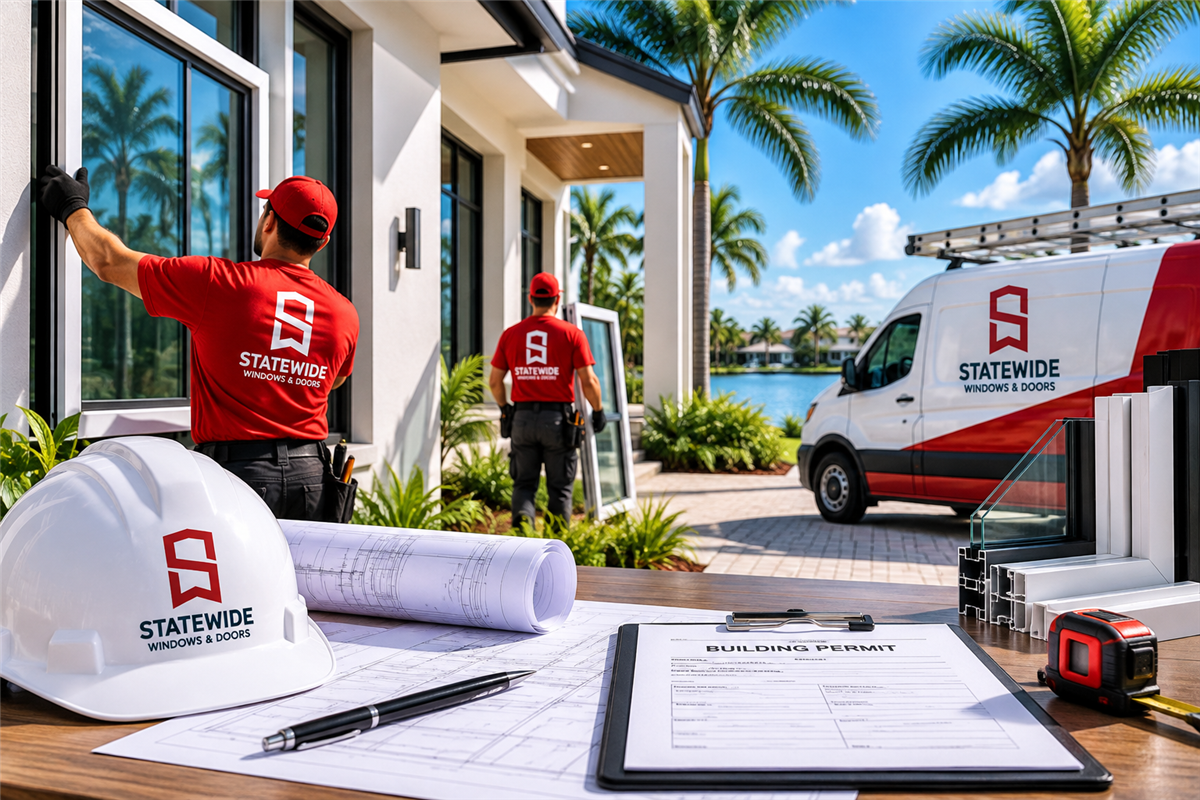
Replacing windows or doors in Florida often involves more than choosing a product and scheduling an installation.
Depending on the property, location, and scope of work, a replacement project may also involve measurements, product approvals, design pressures, permit applications, inspections, corrections, and final permit closeout.
For homeowners, this can create an important question:
What does the impact window contractor actually handle, and what does the homeowner need to do?
There is no single permitting process that works exactly the same way in every Florida city or county.
Requirements can vary based on the local building department, type of property, products being installed, changes to the existing openings, and other project-specific factors.
However, there is a general process homeowners can understand before beginning an impact window or door replacement.
Here is what typically happens during a Florida impact window permit process and where your contractor commonly becomes involved.
Do You Need a Permit to Replace Windows in Florida?
Window and door replacement projects in Florida can require building permits, but homeowners should verify the requirements that apply to their specific property and jurisdiction.
Local building departments administer permits, review project documentation, and conduct required inspections.
This means the exact paperwork or procedure used in Miami-Dade County may not be identical to what is used in another Florida county or municipality.
A professional contractor should determine what permitting requirements apply to the proposed project and explain the process before installation begins.
The Florida Impact Window Permit Process in Simple Terms
A typical replacement project can generally move through stages like these:
Homeowner selects contractor and products
↓
Property and openings are evaluated
↓
Exact window and door configurations are selected
↓
Applicable product approvals and technical documentation are identified
↓
Permit application is prepared and submitted where required
↓
Building department reviews the application
↓
Permit is issued
↓
Products are installed
↓
Required inspection takes place
↓
Corrections are completed if necessary
↓
Permit is finalized or closed out
Not every project will follow exactly the same sequence, but this gives homeowners a useful picture of what happens between signing a contract and completing a permitted installation.
Step 1: The Contractor Evaluates Your Existing Windows and Doors
Before permit paperwork can be prepared, the contractor needs information about what is being replaced.
This typically begins with evaluating the home's existing openings.
The contractor may need to determine:
- How many windows and doors are being replaced
- The approximate dimensions of each opening
- The type of window or door currently installed
- The replacement window or door style
- Whether multiple units share one opening
- Whether mullions are involved
- The wall or substrate conditions
- Whether the opening itself is being altered
The permitting requirements can become different if a homeowner is creating a new opening, changing an opening's size, or performing structural modifications rather than simply replacing an existing unit.
Step 2: Final Measurements Are Taken
Accurate measurements are essential for both manufacturing and permitting.
Impact windows and doors are not simply selected based on a rough width and height.
The exact size and configuration can affect:
- Product approval
- Maximum allowable dimensions
- Design pressure
- Glass configuration
- Mullion requirements
- Anchoring
- Installation details
This is why contractors commonly perform or coordinate final measurements before products are ordered and before final project documentation is completed.
Step 3: The Exact Products and Configurations Are Identified
The permit is not simply for a general category called "impact windows."
The actual products being installed matter.
A contractor may need to document information such as:
- Window or door type
- Product series
- Opening dimensions
- Glass configuration
- Applicable product approval number
- Mullion information where applicable
- Design pressures
- Installation method
Products from the same manufacturer can have different approvals, limitations, sizes, and installation requirements.
That is why the specific configuration matters more than simply knowing the manufacturer's name.
Step 4: The Contractor Identifies the Applicable Product Approval
Impact windows and doors are building-envelope products, and applicable product approval documentation is an important part of many Florida replacement projects.
The contractor should identify the approval documentation that applies to the exact products being proposed.
This may involve:
- A Florida Product Approval
- A Miami-Dade Notice of Acceptance, commonly called an NOA
- Other applicable approval documentation accepted for the project
The existence of an approval number by itself is not enough.
The approval needs to apply to the specific product, configuration, size, installation, and intended application.
Homeowners who want a more detailed explanation can read our guide to Miami-Dade NOA vs. Florida Product Approval.
What Is Product Approval Documentation?
Product approval documents contain technical information about how a window, door, or other building product has been evaluated and how it may be used.
Depending on the approval, this information may include:
- Product models
- Maximum sizes
- Glass types
- Design pressures
- Anchoring requirements
- Fastener types
- Fastener spacing
- Approved substrates
- Mullion configurations
- Installation details
- Limitations of use
- HVHZ approval status where applicable
A knowledgeable contractor should evaluate these details when matching a product to a particular project.
Step 5: Design Pressure Requirements Are Evaluated
Design pressure is an important part of selecting windows and doors for Florida homes.
Wind does not create identical pressure on every window in a building.
The pressure requirements for an opening can be affected by factors such as:
- Property location
- Building height
- Building dimensions
- Wind exposure
- Location of the opening on the structure
- Proximity to corners
- Product size
- Product configuration
The product selected for an opening needs to satisfy the applicable requirements for that installation.
This is another reason a homeowner should be cautious of extremely general statements such as "every impact window works anywhere in Florida."
The actual product and opening matter.
Step 6: Permit Documents Are Prepared
Once the products and project details are established, the information required by the applicable building department can be assembled.
Depending on the jurisdiction and project, permit documentation may include items such as:
- Permit application
- Property information
- Contractor information
- Scope of work
- Window and door locations
- Opening sizes
- Product approval numbers
- Product approval documents
- Design-pressure information
- Mullion information
- Installation details
- Other project-specific documentation
Additional documentation may be required when the work involves changes beyond straightforward replacement.
What Does a Window Schedule or Opening Schedule Show?
Building departments may require information showing which product is being installed at each opening.
This can be organized through an opening schedule, window schedule, elevation drawing, or another format accepted by that jurisdiction.
The purpose is to connect the proposed product documentation to the actual house.
For example, the paperwork may identify:
- Opening number
- Window or door size
- Product type
- Approval number
- Required pressure
- Approved pressure
This helps reviewers determine whether the proposed products correspond with the project being permitted.
What Does the Contractor Commonly Handle?
For a professionally managed impact window project, the contractor commonly coordinates significant portions of the permit process.
Depending on the contract, project, and jurisdiction, this may include:
- Final measurements
- Product selection documentation
- Product approval documents
- Permit preparation
- Permit submission
- Responses to building department questions
- Permit corrections
- Installation scheduling
- Inspection coordination
- Corrections after inspection if required
- Permit closeout
Homeowners should ask exactly what their contractor includes rather than assuming every company handles these responsibilities the same way.
What Might the Homeowner Need to Provide?
Even when the contractor manages permitting, the homeowner may still need to provide information or complete certain tasks.
Depending on the project, this could include:
- Property-owner information
- Signatures on required forms
- Access to the property
- HOA or condominium information
- Association approval documents
- Existing property documentation when requested
- Authorization required by a local jurisdiction
The contractor should explain these responsibilities early enough that they do not unnecessarily delay the project.
HOA Approval and a Building Permit Are Not the Same Thing
This distinction is particularly important for Florida homeowners living in condominiums, gated communities, and homeowners associations.
An HOA or condominium approval is a private association requirement.
A building permit is administered through the applicable government building department.
Receiving HOA approval does not automatically mean you have received a building permit.
Likewise, receiving a building permit does not necessarily mean you have satisfied your association's requirements.
An HOA or condominium association may review items such as:
- Exterior frame color
- Window style
- Door style
- Architectural appearance
- Manufacturer or product information
- Contractor documentation
- Insurance documents
- Work schedules
Statewide's project structure includes HOA coordination for projects where association requirements apply.
Who Submits the Permit?
This depends on the project and contractual arrangement.
When hiring a contractor, homeowners should ask whether the contractor will prepare and submit the applicable permit documentation.
Ask specifically:
- Who is submitting the permit?
- Whose name will appear on the permit?
- Are permit fees included in the contract?
- Who responds if the building department requests corrections?
- Who tracks the application?
- Who schedules inspections?
These questions should be answered before work begins.
What Happens After the Permit Is Submitted?
The building department reviews the application and supporting documentation.
The review process can vary depending on the jurisdiction and complexity of the project.
A permit application may:
- Be approved
- Require additional information
- Receive plan-review comments
- Require corrected documents
- Need additional approvals
A request for corrections does not necessarily mean something is wrong with the entire project.
It may simply mean the building department needs additional or revised information before issuing the permit.
Who Handles Permit Corrections?
When the contractor is managing the permit, the contractor or its permitting team commonly coordinates responses to comments related to the construction scope or product documentation.
For example, a reviewer could request clarification regarding:
- A product approval
- An opening size
- A pressure requirement
- A mullion
- A drawing
- A missing document
- A discrepancy in the application
The required response depends on the actual review comment.
Homeowners should ask who will communicate with them if an additional signature or document is needed.
How Long Does an Impact Window Permit Take?
There is no single permit timeline that applies to every Florida impact window project.
Processing time can vary based on:
- City or county
- Project complexity
- Application completeness
- Building department workload
- Required reviews
- Corrections
- HOA requirements
- Whether structural modifications are involved
For that reason, homeowners should be cautious of treating a general permit estimate as a guaranteed approval date.
A contractor can prepare and track a permit application, but the contractor does not control how quickly a government agency completes every stage of its review.
Can Windows Be Installed Before the Permit Is Issued?
When a permit is required for the work, installation should follow the applicable permitting requirements.
A homeowner should not assume that signing a contract or submitting a permit application means the permit has already been issued.
Ask your contractor to explain when the project will be authorized to proceed and how you can confirm the permit status.
Step 7: Installation Takes Place
After the applicable approvals and scheduling steps are completed, installation can begin.
The installation needs to correspond with the products and installation requirements associated with the project documentation.
This is important because product approval is about more than the glass itself.
Installation details can involve:
- Anchors
- Fastener spacing
- Embedment
- Substrate
- Mullions
- Frame configuration
- Sealants
- Opening preparation
The exact requirements depend on the approved system and project conditions.
The Permit and Installation Need to Match
A building permit is not simply paperwork completed before construction.
The products shown in the permitted documentation should correspond with what is actually installed.
If a product, size, configuration, or other significant project detail changes, additional documentation or revisions may be necessary depending on the circumstances and local requirements.
This is why accurate measurements and product selection before installation are so important.
Step 8: Required Inspections Are Completed
Permitted work can be subject to inspection by the applicable building department.
The purpose of an inspection is to determine compliance with applicable requirements for the permitted work.
The exact inspection procedure can vary by jurisdiction and project.
Depending on the project, the inspector may evaluate information or conditions involving:
- The installed products
- Product identification
- Installation
- Anchoring
- Opening conditions
- Permit documentation
- Other applicable code requirements
Homeowners should ask their contractor what inspections are expected and whether someone needs to be present.
What Happens If an Inspection Does Not Pass?
An inspection correction does not automatically mean the entire installation needs to be removed.
The required response depends on why the inspection was not approved.
Examples could include:
- Additional documentation is needed
- A condition needs clarification
- An installation item needs adjustment
- A permit document needs correction
- Another required step needs to be completed
The contractor should determine what correction is required, address the applicable item, and coordinate the next inspection or documentation step.
Step 9: Permit Closeout
A project should not be considered complete from a permitting standpoint simply because the physical windows or doors have been installed.
Where a permit applies, the project may need to progress through required inspections and finalization before the permit is closed.
Permit closeout provides an important final administrative step for the permitted work.
Homeowners should ask their contractor whether the permit has reached its final required status rather than assuming installation day automatically closes it.
Why Permit Closeout Matters
Closing out permits helps establish that the permitted project has progressed through the applicable local process.
An unresolved or open permit can create questions later, particularly when homeowners:
- Sell the property
- Research previous improvements
- Apply for additional permits
- Need records of completed work
After the project is complete, homeowners can ask how to confirm that applicable inspections and permit closeout have been completed.
Miami-Dade Impact Window Permits
Miami-Dade County has detailed requirements for replacement windows, mullions, and glass doors.
Current county guidance for replacement projects calls for permit information that identifies the products and openings involved in the work.
For example, documentation can include:
- Window and glass-door sizes
- Locations of the units being replaced
- Applicable product approval numbers
- Mullion information where applicable
- Glass and configuration information
Miami-Dade also maintains its Product Control system, where product approvals can be researched.
Because Miami-Dade is within Florida's High-Velocity Hurricane Zone, the specific products and configurations proposed for a project need to be appropriate for the intended HVHZ application.
Broward County Impact Window Permits
Broward County is also part of Florida's High-Velocity Hurricane Zone.
Homeowners in Broward should therefore expect product approval and wind-related requirements to be important parts of an impact window or door project.
However, permitting is administered through the applicable authority having jurisdiction, and procedures can differ depending on the municipality and property.
A project in Fort Lauderdale, Hollywood, Pembroke Pines, Coral Springs, or another Broward community should be evaluated according to the requirements that apply to that specific jurisdiction.
The contractor should determine where the permit needs to be filed and which documents are required.
What Is Different About the HVHZ?
Miami-Dade and Broward County make up Florida's High-Velocity Hurricane Zone, or HVHZ.
Product selection and documentation in these counties require particular attention to whether the exact product and configuration are approved for the intended HVHZ application.
One recognized pathway is a qualifying Miami-Dade Notice of Acceptance.
A qualifying Florida Product Approval specifically approved for HVHZ use can also be applicable.
A generic Florida Product Approval does not automatically mean that every listed product can be used within the HVHZ.
The approval details matter.
For a complete explanation, read Miami-Dade NOA vs. Florida Product Approval: What Florida Homeowners Need to Know.
Impact Resistant Does Not Automatically Mean Approved for Every Project
The phrase "impact resistant" describes an important product characteristic, but it does not replace permit or product-approval review.
A product can be impact resistant while still having limitations involving:
- HVHZ use
- Maximum dimensions
- Design pressures
- Glass options
- Installation methods
- Substrates
That is why the contractor should verify the approval documentation associated with the exact proposed configuration.
What If You Are Changing the Size of the Window Opening?
Changing an existing opening can create a different scope of work than replacing a window with another unit in the existing opening.
Structural modifications, new openings, opening enlargement, or opening reduction may require additional plans, details, engineering, or other documentation depending on the project and jurisdiction.
Tell your contractor early if you want to change the size, location, or shape of an existing window or door.
Do not assume the permitting requirements will be identical to a standard replacement.
What If You Are Replacing a Sliding Glass Door?
Sliding glass doors are also exterior building components, and replacement projects may involve many of the same permitting considerations as windows.
Depending on the project, documentation can involve:
- Opening size
- Door configuration
- Glass information
- Product approval
- Design pressure
- Installation requirements
Large sliding glass door openings can require careful evaluation because product size and configuration can affect the approved performance of the system.
Can the Homeowner Pull the Permit?
Florida provides circumstances in which property owners may act as owner-builders, subject to applicable laws and requirements.
However, a homeowner who hires a contractor should clearly understand who is responsible for permitting the contracted work.
If a company expects you to obtain the permit yourself, ask why and understand the implications before proceeding.
The contractual relationship and the permitting relationship should be clear.
Permit Fees: Are They Included in the Window Quote?
This depends on the contractor and proposal.
Before signing, review whether permit-related costs are:
- Included in the project price
- Listed as a separate line item
- Estimated and adjusted later
- Paid directly by the homeowner
Do not assume every impact window quote includes the same permitting expenses.
This is one reason homeowners should compare the complete scope of competing proposals instead of comparing only the final price.
Questions to Ask Your Contractor About Permits
Before signing an impact window contract, ask:
- Does my project require a permit?
- Which building department has jurisdiction?
- Who prepares the permit?
- Who submits it?
- Are permit fees included?
- Who supplies the product approval documentation?
- Who verifies design-pressure requirements?
- Who handles plan-review corrections?
- Will you tell me when the permit is issued?
- Who schedules the inspection?
- Who handles inspection corrections?
- Who verifies the permit is closed?
These questions help establish responsibilities before the project begins.
Common Misunderstandings About Florida Window Permits
"My windows are impact rated, so I don't need product documentation."
Impact resistance does not eliminate the need to evaluate applicable product approvals and permit requirements.
"My HOA approved the windows, so the permit is approved."
HOA approval and government permitting are separate processes.
"The contractor submitted the permit, so we're ready to install."
Submission and permit issuance are not necessarily the same stage.
"Every Florida city requires exactly the same paperwork."
Local procedures can vary.
"Any Florida Product Approval works in Miami-Dade or Broward."
No. The specific approval must be appropriate for its intended application. For HVHZ projects, verify whether the applicable approval includes HVHZ use.
"Once installation is finished, the permit automatically closes."
A permitted project may still require inspections and final administrative steps.
How Homeowners Can Help Avoid Permit Delays
Homeowners cannot control every part of the permitting process, but they can help keep their project organized.
Before the project begins:
- Provide accurate property information
- Tell the contractor about HOA or condominium requirements
- Return required signatures promptly
- Decide on product configurations before permit submission where possible
- Tell the contractor about planned changes to openings
- Provide requested documents promptly
- Keep contact information current
Changes made after documentation has already been prepared can sometimes require additional review.
Why an Experienced Permitting Team Matters
Permitting involves more than filling out a form.
A well-managed project may require coordination between:
- The homeowner
- Contractor
- Permit department
- Product documentation
- HOA or condominium association
- Production team
- Installation team
- Inspectors
A contractor familiar with the process can help organize these moving parts and communicate what is required at each stage.
That experience can be particularly valuable for projects involving jurisdictions where impact window permitting is a routine part of hurricane-protection construction.
How Statewide Handles the Project Process
At Statewide Windows & Doors, permitting is part of the larger project-management process rather than an isolated piece of paperwork.
Statewide's current team includes professionals working in areas such as production, permitting, HOA coordination, field operations, project management, installation, and customer service.
That structure allows different stages of a project to be coordinated as the job progresses from product selection and measurements toward installation and completion.
Statewide also has extensive experience completing projects in Miami-Dade and Broward County, with thousands of projects completed across the two counties.
You can learn more in our guide: Can Statewide Install Impact Windows in Miami-Dade & Broward County?
Why Choose Statewide Windows & Doors?
Statewide Windows & Doors provides impact window and door installation services throughout multiple Florida markets.
Our team brings more than 25 years of combined industry experience across different parts of the home improvement process.
Our project structure includes team members involved in:
- Product consultation
- Measurements and production
- Permitting
- HOA coordination
- Project management
- Field operations
- Installation
- Customer service
Statewide offers a variety of impact window and door systems, with aluminum and vinyl options available depending on the needs of the project.
Homeowners can learn more about our Impact Windows, Impact Doors, Completed Projects, and Florida Service Areas.
Final Words
A Florida impact window permit can involve considerably more than submitting a basic application.
The overall process can require accurate measurements, exact product information, applicable product approvals, design-pressure information, permit documents, installation, inspections, corrections, and final closeout.
Your contractor commonly handles or coordinates many of these responsibilities, but homeowners should never assume what is included.
Ask before signing.
Find out who prepares the permit, who submits it, who provides product documents, who responds to corrections, who schedules inspections, and who makes sure the permit reaches its required final status.
If your home is in Miami-Dade or Broward County, also make sure the specific products and configurations proposed for your project are approved for their intended application within Florida's High-Velocity Hurricane Zone.
Most importantly, remember that Florida permitting is local.
The exact requirements for your project depend on the property, scope of work, products, and authority having jurisdiction.
A contractor should be able to identify those requirements, explain the process in understandable terms, and help guide the project from documentation through installation and final completion.
Tags
Subscribe to Statewide Windows & Doors's Blog







Comments