 Free Estimate
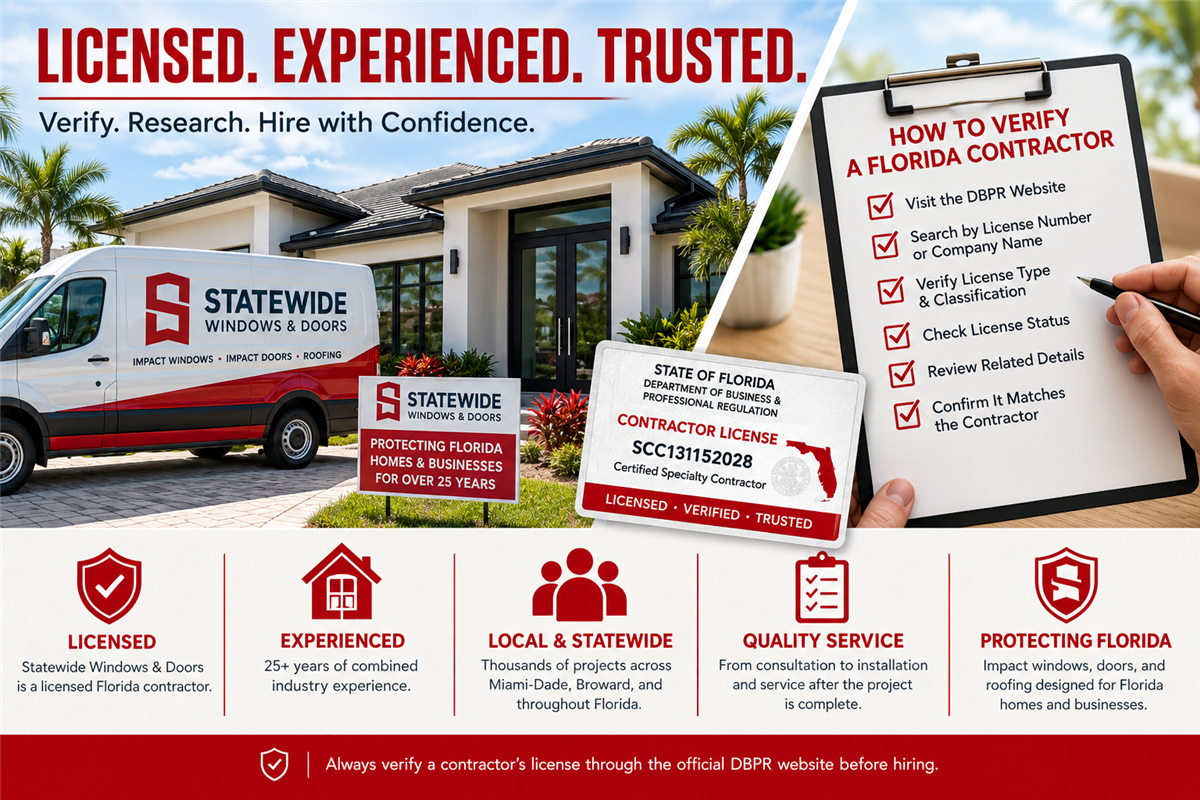
If you're considering Statewide Windows & Doors for impact windows, doors, roofing, or another home improvement project, one of the most important questions to ask is simple:
Is Statewide Windows & Doors licensed in Florida?
Yes. Statewide Windows & Doors publishes its Florida contractor licensing information for homeowners to review.
But homeowners should never rely solely on a license number printed on a contractor's website, advertisement, business card, or proposal.
Florida provides official resources that allow consumers to independently verify contractor licensing information before hiring a company.
That is something we encourage homeowners to do when researching Statewide—and when researching any other Florida contractor.
In this guide, we'll explain why contractor licensing matters, how to verify a Florida contractor, what information to look for, and why licensing should be only one part of your research before signing a home improvement contract.
Is Statewide Windows & Doors Licensed in Florida?
Statewide Windows & Doors operates as a licensed Florida contractor and publishes contractor licensing information on its website.
Because licenses and their statuses can change over time, homeowners should verify current information through the appropriate official Florida licensing database before relying on any license number found online.
This applies to Statewide as well as any other contractor you are considering.
Independent verification gives homeowners an opportunity to confirm that the information provided by a contractor matches current official records.
Why Contractor Licensing Matters in Florida
Replacing windows, doors, or a roof is very different from purchasing an ordinary household product.
These projects can affect important parts of the home's exterior and may involve:
- Structural openings
- Wind resistance
- Water resistance
- Product approvals
- Permitting
- Inspections
- Installation requirements
- Building-code requirements
Florida's construction industry is regulated, and different types of construction work may require appropriate contractor licensing.
Verifying licensing is therefore one of the first steps homeowners should take when researching a contractor.
How to Verify a Florida Contractor License
Florida homeowners can independently research contractor licensing through the state's official licensing resources.
The Florida Department of Business and Professional Regulation, commonly known as the DBPR, provides tools for consumers to research licensed professionals and businesses.
When checking a contractor, homeowners should use current official records rather than relying exclusively on information presented by the contractor itself.
Information that can help with your search includes:
- Contractor name
- Business name
- License number
- License type
- License status
If a contractor provides a license number, search that number through the applicable official database and compare the information with the company you are considering.
Do Not Simply Check Whether a License Number Exists
Finding a license number is only part of the verification process.
You should also review the information associated with that license.
Look for details such as:
- Who holds the license
- The license classification
- The current status
- Whether the information corresponds with the contractor you are researching
- Any other information available through the official record
The goal is not simply to find numbers on a website.
The goal is to confirm that the contractor's representations correspond with current official information.
Why You Should Use Official Sources
Homeowners frequently encounter contractor information through Google, social media, advertisements, review websites, directories, and lead-generation websites.
Those sources may be useful for discovering companies, but they should not replace official licensing records.
A third-party website can contain outdated information.
A contractor's own website can also contain information that has not yet been updated.
Official government records are the better place to verify current licensing status.
What Does a Contractor License Tell You?
Contractor licensing is an important qualification, but homeowners should understand what it does and does not tell them.
A license can help establish that the contractor has met requirements associated with the applicable license classification.
However, licensing alone does not tell you everything about the customer experience.
A license does not automatically tell you:
- How clearly a company communicates
- How cleanly its crews work
- How quickly questions are answered
- How projects are managed
- Whether customers are satisfied
- How service requests are handled
- Whether the specific product proposed is appropriate for your opening
That is why licensing should be one part of a broader contractor evaluation.
A Licensed Contractor and an Approved Product Are Two Different Things
This distinction is particularly important when researching impact windows and doors.
A contractor's license relates to the contractor.
A product approval relates to the product and its approved configurations and applications.
These are not interchangeable.
A contractor can be appropriately licensed while homeowners still need to confirm that the specific window or door configuration proposed for their project is suitable for its intended application.
When researching an impact window project, evaluate both the contractor and the products being proposed.
What About Florida Product Approval?
Florida homeowners researching impact windows frequently encounter the term Florida Product Approval.
This is separate from contractor licensing.
Product approval documentation can contain important information about a window or door system, including approved configurations and installation requirements.
Do not assume that simply seeing the words "Florida approved" tells you everything you need to know.
The specific product, configuration, size, installation method, and intended application matter.
What About Miami-Dade NOA?
South Florida homeowners may also encounter products with a Miami-Dade Notice of Acceptance, commonly called a Miami-Dade NOA.
A Miami-Dade NOA is a recognized product-approval pathway.
However, homeowners should avoid assuming that every product used in Miami-Dade or Broward County universally requires a Miami-Dade NOA.
A qualifying Florida Product Approval specifically approved for use within the High-Velocity Hurricane Zone may also be applicable.
The important question is whether the specific product and configuration is approved for its intended application.
Understanding the High-Velocity Hurricane Zone
Miami-Dade and Broward counties are within Florida's High-Velocity Hurricane Zone, commonly abbreviated as HVHZ.
Homeowners in these areas should pay particular attention to the documentation associated with the products being proposed for their projects.
Depending on the product and project, documentation can address areas such as:
- Impact resistance
- Design pressures
- Approved sizes
- Configurations
- Anchoring
- Fasteners
- Installation limitations
This is one reason experience with South Florida projects can be valuable when selecting a window and door contractor.
Statewide's Experience in Miami-Dade and Broward
Although Statewide Windows & Doors serves homeowners across multiple Florida markets, the company also has substantial project experience in South Florida.
Statewide has completed thousands of projects across Miami-Dade and Broward County.
For homeowners researching a contractor, completed work in the local market can provide useful context alongside licensing.
It demonstrates that the company has worked on actual projects within the communities it serves rather than simply advertising within those areas.
Homeowners can explore Statewide's completed projects and Florida service areas while researching the company.
Does Being a Statewide Company Mean Statewide Isn't Local?
No.
A contractor can serve multiple Florida markets while also maintaining substantial experience within individual communities.
Statewide is headquartered in Boca Raton and serves a broader Florida footprint, including communities throughout South Florida and other parts of the state.
Rather than judging a contractor solely by the size of its service area, homeowners should ask:
- Does the company complete projects in my area?
- Does it understand the applicable permitting process?
- Does it have experience with projects similar to mine?
- Can it provide evidence of completed work?
- Does it have systems for project management and customer service?
These questions can provide more useful information than simply asking whether a company serves one city or many.
Licensing Should Be Verified Before You Sign
The best time to research contractor credentials is before signing a contract.
Do not wait until a project has already begun.
Before signing, homeowners should consider verifying:
- Company identity
- Applicable contractor licensing
- Current license status
- Contract information
- Scope of work
- Product information
- Permit responsibilities
- Warranty terms
- Payment schedule
Taking time to review these details can help you understand exactly who you are hiring and what you are purchasing.
Make Sure the Company on the Contract Is Clear
Home improvement projects may involve sales representatives, installers, project managers, subcontractors, manufacturers, and other parties.
Homeowners should understand which company they are actually entering into an agreement with.
Review the contract carefully and make sure the business information is clear.
Look for:
- Legal business name
- Company contact information
- Contractor information
- Project address
- Scope of work
- Products being purchased
- Payment terms
- Warranty information
If something is unclear, ask for clarification before signing.
Ask Who Is Responsible for Permitting
Impact window and door replacement projects may require permits depending on the project and jurisdiction.
Before hiring a contractor, understand who will manage the permitting process.
Questions worth asking include:
- Who prepares the permit application?
- Who submits the permit?
- Who provides product approval documents?
- Who responds if additional documentation is requested?
- Who schedules required inspections?
- Who follows the permit through completion?
Statewide's organization includes personnel dedicated to permitting and project coordination for applicable projects.
Permits and Contractor Licenses Are Not the Same Thing
Another common source of confusion is the difference between a contractor license and a building permit.
A contractor license relates to the contractor's authorization and classification.
A permit relates to a specific construction project.
A contractor may hold an applicable license while an individual project still requires a separate permit from the appropriate local authority.
Homeowners should understand both parts of the process.
Ask About Inspections
Depending on the project and jurisdiction, inspections may be required after installation or at specific stages of the work.
Ask the contractor how required inspections are coordinated.
Useful questions include:
- What inspections are expected?
- Who schedules them?
- Does the homeowner need to be present?
- What happens if a correction is required?
- Who confirms final permit closeout?
Requirements vary, so avoid assuming every Florida project follows exactly the same inspection process.
Research the Contractor's Actual Work
After verifying licensing, look for evidence that the contractor actually performs the type of work you need.
For an impact window company, that might include completed projects involving:
- Impact windows
- Sliding glass doors
- Entry doors
- French doors
- Large window openings
- Condominiums
- Single-family homes
Statewide publishes completed-project information that homeowners can use alongside licensing and reviews when researching the company.
Looking at actual completed projects can help establish whether a contractor has experience with projects similar to yours.
Read Customer Reviews Too
Licensing tells you one part of the story.
Customer reviews tell you something different.
When reading reviews, look for recurring comments about:
- Communication
- Project management
- Installation crews
- Cleanliness
- Scheduling
- Permitting
- Inspections
- Service
- Finished work
Instead of focusing on one unusually positive or negative review, look for patterns across many customer experiences.
Homeowners can read Statewide Windows & Doors reviews while researching the company.
Look at Company History and Experience
Licensing is important, but experience also matters.
Statewide Windows & Doors was founded by John Dyda after years of hands-on experience installing windows in Florida.
Today, Statewide's team brings more than 25 years of combined industry experience across different areas of the business.
That distinction is important.
"Combined experience" describes experience across members of a team. It should not be interpreted as meaning one individual has personally operated the company for that entire period.
Homeowners can learn more on the About Statewide Windows & Doors page.
Verify Insurance Requirements Too
Licensing is not the only credential homeowners may want to discuss with a contractor.
Depending on the project, you may also want to ask about applicable insurance coverage.
Ask the contractor what documentation is available and whether additional documentation is required by your municipality, condominium association, homeowners association, or other party involved in the project.
Requirements can vary, so confirm what applies to your specific situation rather than assuming every project requires identical documentation.
Be Careful With Contractor Claims Online
Homeowners researching contractors encounter a tremendous amount of marketing language.
Some companies may describe themselves using terms such as:
- "The best"
- "Number one"
- "Top rated"
- "Hurricane proof"
- "Fully approved everywhere"
Claims like these should not replace actual verification.
Instead, look for specific evidence.
Verify licensing. Review completed projects. Research applicable products. Read customer experiences. Understand the warranty. Ask about permits and inspections.
Specific, verifiable information is generally more useful than broad marketing claims.
Red Flags When Researching a Florida Contractor
Homeowners should be cautious if a contractor:
- Refuses to provide identifying business information
- Provides licensing information that cannot be verified
- Pressures you not to research the company
- Will not explain who is responsible for permitting
- Cannot identify the products being proposed
- Will not provide important project details in writing
- Makes absolute claims about hurricane performance
- Guarantees specific insurance savings
- Cannot explain warranty coverage
- Pressures you to sign immediately without reviewing the agreement
One unusual detail does not necessarily establish that a company is untrustworthy, but homeowners should investigate anything that does not make sense.
What Should You Verify Before Hiring an Impact Window Company?
Before hiring an impact window contractor in Florida, use a broader checklist than licensing alone.
Contractor
- Verify applicable licensing
- Confirm company identity
- Research company history
- Review customer feedback
- Look at completed projects
Products
- Identify the exact manufacturer
- Identify the product series
- Review the proposed configuration
- Ask which product approval applies
- Ask whether the configuration is appropriate for the intended application
Project
- Understand permitting responsibilities
- Ask about inspections
- Review the scope of work
- Understand the project timeline
- Review payment terms
After Installation
- Understand warranty coverage
- Ask how service requests are handled
- Know who to contact if a problem develops
This approach gives homeowners a much more complete understanding of the contractor and the proposed project.
How to Research Statewide Windows & Doors
If you're considering Statewide Windows & Doors, we encourage you to research us using the same standards you would apply to any contractor.
You can:
- Verify applicable licensing through current official records
- Read Statewide customer reviews
- Review completed projects
- Research our company history
- Explore our service areas
- Ask about the exact products proposed for your home
- Ask how your permit will be handled
- Ask about applicable inspections
- Review warranty information
- Ask how post-installation service works
Our goal is for homeowners to understand what they are purchasing and who will be responsible for the project.
Why Choose Statewide Windows & Doors?
Statewide Windows & Doors provides impact window, impact door, and exterior remodeling services for homeowners across Florida.
Our company combines hands-on industry experience with departments dedicated to different stages of the homeowner experience.
Depending on the project, Statewide's team can include professionals working in:
- Sales and consultation
- Project management
- Production
- Permitting
- HOA coordination
- Field operations
- Installation
- Customer service
Statewide's team brings more than 25 years of combined industry experience, and the company has completed thousands of projects across Miami-Dade and Broward County in addition to projects throughout other Florida markets.
Homeowners can explore our Impact Windows, Impact Doors, Customer Reviews, and About Statewide resources before making a decision.
Final Words
So, is Statewide Windows & Doors licensed in Florida?
Statewide operates as a licensed Florida contractor and publishes its licensing information for homeowners to review.
But we encourage homeowners to go one step further.
Verify it independently.
Use current official Florida licensing records to research Statewide or any other contractor before entering into a major home improvement agreement.
Then look beyond licensing.
Research completed projects. Read customer reviews. Understand the company's experience. Ask about permits and inspections. Review the exact products being proposed. Understand warranty coverage and post-installation service.
A contractor license is an important part of your research, but the strongest hiring decision comes from evaluating the entire company and the entire project.
At Statewide Windows & Doors, we believe homeowners should have the information they need to make that decision confidently and carefully.
Tags
Subscribe to Statewide Windows & Doors's Blog






Comments