 Free Estimate
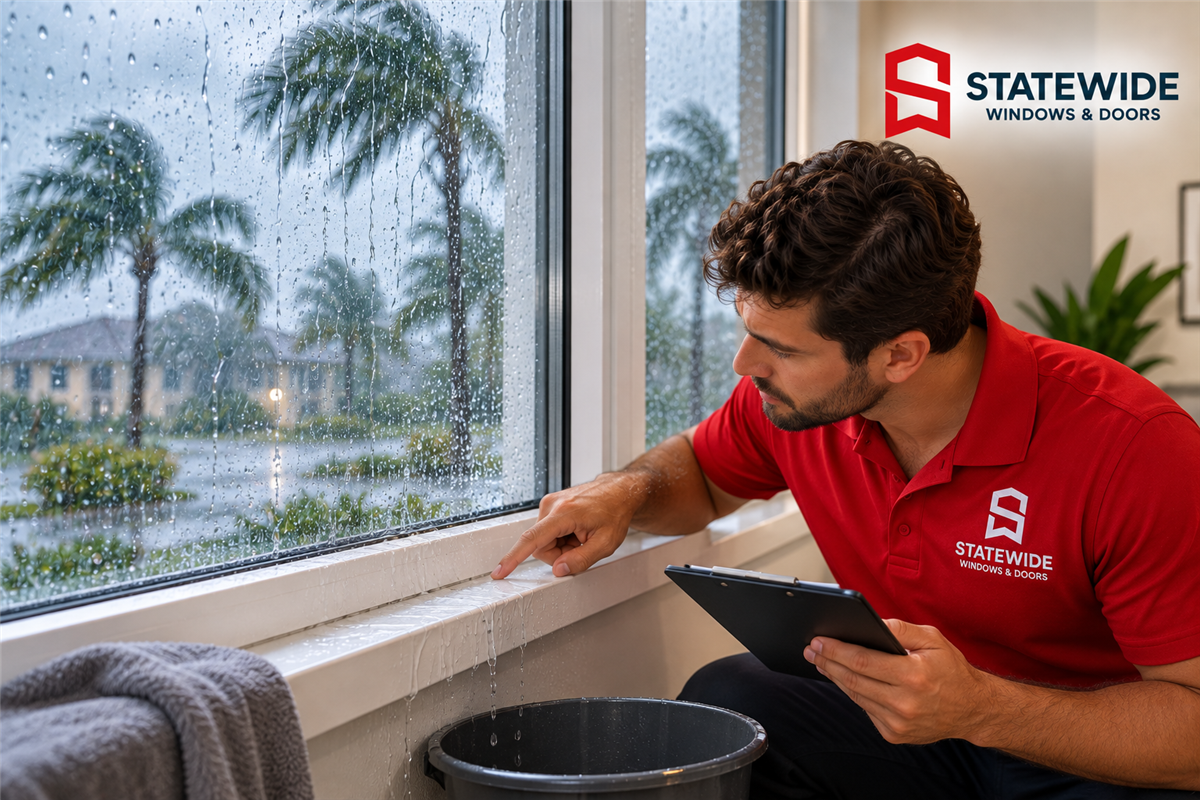
Impact windows are designed to provide Florida homes with protection from windborne debris and severe weather, but homeowners sometimes notice water around a window during heavy rain and immediately assume the impact window has failed.
Water around a window does not always mean the glass or window itself is defective.
Windows are part of a larger building envelope that includes the frame, installation, sealants, drainage features, surrounding walls, roof, stucco, and other components.
During Florida's intense thunderstorms and wind-driven rain, identifying where water actually entered can be more complicated than simply looking at where it appears inside the home.
Here are some of the most common reasons homeowners may notice water around impact windows and what to consider before attempting a repair.
Can Impact Windows Leak?
Impact-resistant does not mean that a window is completely immune to every possible water-related problem.
Impact resistance primarily relates to the window system's ability to meet specified testing and performance requirements.
Water performance is another important part of window design and installation.
If water appears around an impact window, the source should be investigated rather than assuming the impact glass itself is responsible.
Impact Resistance and Water Resistance Are Not the Same Thing
One common misunderstanding is that an impact-rated window should be completely waterproof under every possible weather condition.
Impact resistance and water resistance describe different performance characteristics.
A window can be designed for hurricane-related impact protection while also having separate requirements related to air and water performance.
The complete product, installation, building opening, and surrounding construction all matter.
Why Florida Rain Can Expose Window Problems
Florida storms can combine heavy rainfall with strong winds.
Wind-driven rain can place much more pressure on windows and exterior walls than an ordinary light rain.
Water can be pushed against:
- Window frames
- Glass
- Exterior sealants
- Stucco
- Wall penetrations
- Roof and soffit areas
- Door and window openings
A condition that is not noticeable during ordinary rainfall may become visible during a strong storm.
Where You See Water May Not Be Where It Entered
This is one of the most important concepts homeowners should understand about water intrusion.
Water can travel behind walls, along framing, or through surrounding building materials before becoming visible inside the home.
For example, water appearing at the bottom of a window does not automatically prove that it entered through the bottom of the window.
The actual entry point may be somewhere above or beside the visible moisture.
Check Whether the Water Is Inside or Outside the Window System
Before assuming there is a leak, look carefully at where the moisture is located.
Water may appear:
- On the interior glass surface
- Between panes of glass
- On the interior window sill
- Inside the track
- Around the frame
- On the surrounding drywall
- Below the window
- Above the window
Each location can point toward a different type of condition.
Water in a Window Track Does Not Always Mean the Window Is Leaking
Some window systems are designed to manage incidental water through internal drainage paths.
Depending on the product, water that reaches certain areas of the window can be directed toward exterior drainage openings.
Seeing some water in an exterior-facing track or drainage area does not automatically mean water is entering the home's interior.
The important question is whether the drainage system is functioning as intended and whether water is crossing into areas where it should not be.
What Are Window Weep Holes?
Many window systems include small drainage openings commonly referred to as weep holes.
These openings allow water within designated portions of the window system to drain toward the exterior.
They may look like small slots or openings in the frame.
Homeowners sometimes mistake these intentional openings for missing caulk or construction defects.
Do Not Caulk Over Window Weep Holes
One of the most important maintenance mistakes to avoid is sealing an intentional drainage opening.
If a homeowner sees a small opening in the exterior frame and fills it with caulk without determining its purpose, water may no longer be able to drain as intended.
Before sealing any opening in a window frame, determine whether it is part of the product's drainage system.
Can Weep Holes Become Clogged?
Depending on the window design and environment, drainage areas can collect debris.
Possible buildup can include:
- Dirt
- Sand
- Dust
- Insects
- Paint
- Construction debris
- Other material
If drainage features become obstructed, water may not move through the system as intended.
Homeowners should follow manufacturer maintenance instructions when cleaning drainage areas.
Do Not Drill New Drainage Holes Into an Impact Window
If you suspect that a window is not draining correctly, do not drill additional holes into the frame.
Impact windows are manufactured as specific systems.
Unapproved drilling or modification can damage the frame and alter the product from its intended configuration.
Have the drainage system evaluated instead.
Exterior Sealant Can Be a Source of Water Problems
Sealants are commonly used around window installations to help manage water at the connection between the window and surrounding construction.
Exposed sealants can experience years of Florida sun, heat, rain, and building movement.
Homeowners may eventually notice:
- Cracking
- Gaps
- Separation
- Missing material
- Visible deterioration
Damaged exterior sealant may deserve professional evaluation.
More Caulk Is Not Always the Correct Solution
When homeowners see water, a common reaction is to apply more caulk everywhere around the window.
That can create problems if the actual source has not been identified.
Improper sealant can:
- Block drainage openings
- Trap water
- Cover evidence of the actual entry point
- Interfere with window operation
- Fail to address water entering from another location
Identify the source before applying a permanent repair.
Can Water Enter Around the Window Frame?
Yes, conditions involving the connection between the frame and building opening can potentially contribute to water intrusion.
This is why window installation involves more than simply placing a new window into an opening.
The opening, fastening, sealing, product instructions, and surrounding construction all matter.
Can Improper Installation Cause Water Intrusion?
Installation quality is an important part of window performance.
Impact windows should be installed according to applicable requirements and the instructions associated with the specific product and project.
If installation details are incorrect or incomplete, water-management performance can be affected.
This is one reason homeowners should evaluate the contractor as carefully as the window product itself.
Can Water Come Through the Wall Instead of the Window?
Yes.
Water appearing near a window can sometimes originate from the surrounding building envelope rather than the window itself.
Possible areas that may require investigation include:
- Stucco
- Exterior wall cracks
- Roof areas
- Flashing
- Parapets
- Balconies
- Exterior penetrations
- Openings above the window
The appropriate professional may depend on where the actual problem originates.
Stucco Cracks Can Complicate Leak Diagnosis
Florida homes commonly use stucco exterior finishes.
If cracking or separation exists around a window or elsewhere on the wall, water can potentially travel through areas outside the window assembly.
A window technician may determine that the window itself appears intact while additional evaluation of the surrounding wall is necessary.
Can the Roof Cause Water Around a Window?
Potentially.
Water can travel through building assemblies before becoming visible at an interior surface.
If moisture appears above a window, near a ceiling, or along a wall after heavy rain, the investigation may need to include areas beyond the window.
Do not automatically replace a window until the actual source has been identified.
What Is Wind-Driven Rain?
Wind-driven rain occurs when wind pushes rainfall against a building rather than allowing it to fall mostly vertically.
During severe Florida thunderstorms or tropical weather, rain can strike walls and windows at significant angles.
This can expose parts of the building envelope to water conditions that may not occur during ordinary rain.
Why Does My Window Only Leak During Strong Storms?
If moisture appears only during heavy wind-driven rain, that information can be useful during diagnosis.
Record details such as:
- Wind direction
- Location of the affected window
- Where water first appeared
- Whether the issue occurs during ordinary rain
- How long the rain had been falling
- Whether the window was fully closed and locked
These observations can help a professional reproduce or investigate the condition.
Make Sure the Window Is Fully Closed and Locked
Operable windows should be placed in their intended closed and locked position during severe weather.
A sash that appears closed but is not fully seated may not perform the same way as a properly secured window.
If the lock will not engage or the window cannot close completely, the operating issue should be addressed.
Can a Hard-to-Close Window Contribute to Water Problems?
A window that is not reaching its intended closed position deserves evaluation.
Possible causes can include:
- Debris
- Hardware problems
- Alignment
- Weatherstripping issues
- Frame damage
Do not force the window or modify the locking system to compensate.
Can Damaged Weatherstripping Allow Water In?
Weatherstripping is one component involved in the performance of operable windows.
If it becomes damaged, displaced, torn, or missing, the window may no longer close against those surfaces as intended.
Weatherstripping should not simply be removed because it creates resistance.
If it is damaged, use an appropriate replacement for the specific window system.
Can Old Impact Windows Develop Water Problems?
Age alone does not mean an impact window will leak.
However, older windows may have components that deserve closer inspection, including:
- Exterior sealants
- Weatherstripping
- Locks
- Hardware
- Drainage areas
- Glass units
- Surrounding construction
The actual condition is more useful than age alone when determining what needs attention.
Can New Impact Windows Leak?
If water appears around a recently installed impact window, notify the contractor so the condition can be evaluated.
Do not assume that a new installation simply needs time to "settle."
Document where and when the water appears and provide photographs or video if possible.
That information can make troubleshooting easier.
Water on the Inside of the Glass May Be Condensation
Not every drop of water on a window comes from rain.
Condensation can form on an accessible glass surface when the glass temperature and surrounding humidity conditions allow moisture to collect.
Florida's humidity and indoor air-conditioning conditions can sometimes make condensation noticeable.
Surface condensation should be distinguished from rainwater intrusion and between-pane moisture.
Condensation Is Different From a Window Leak
If moisture forms evenly across the interior glass surface, especially under certain temperature and humidity conditions, condensation may be involved.
If water appears from a specific frame joint during rainfall, a different condition may be present.
Observe when and where the moisture develops.
What Does Fog Between the Glass Panes Mean?
For insulated glass units, persistent fog or moisture trapped between panes can indicate a condition involving the sealed glass assembly.
This is different from rain entering around the window.
Because the moisture is between panes, wiping the interior and exterior glass will not remove it.
The glass unit may need evaluation.
Can Cracked Impact Glass Allow Water Problems?
Significantly damaged glazing should be evaluated.
A crack, chip, or other damage can affect the condition of the window assembly.
Homeowners should not simply apply household sealant to cracked impact glass and assume the original performance has been restored.
The correct repair depends on the specific product and damage.
What If Water Appears at the Bottom Corners?
Water visible at a lower corner does not automatically identify the entry point.
Gravity can cause water entering higher in the assembly or surrounding wall to travel downward before becoming visible.
Document the exact location, but avoid assuming that the bottom corner itself is necessarily the source.
What If Only One Window Leaks?
If several windows experience the same storm but moisture appears at only one location, that comparison can be useful.
The affected opening may have a localized condition involving:
- Installation
- Sealant
- Drainage
- Hardware
- Surrounding wall construction
- Physical damage
Each opening should be evaluated individually.
What If Multiple Windows Leak?
When multiple windows show similar symptoms, the investigation may need to consider shared conditions such as installation details, maintenance, severe weather exposure, or surrounding building-envelope issues.
Do not assume every affected window independently developed the same glass defect.
Look for patterns.
Can Pressure Washing Cause Water Around Windows?
High-pressure water directed at windows, seals, joints, or surrounding construction can create conditions different from ordinary rainfall.
Homeowners should avoid directing powerful pressure-washing equipment into window joints, drainage areas, or seals.
Follow appropriate cleaning recommendations for the windows and exterior surfaces.
Can a Garden Hose Be Used to Test for a Leak?
Randomly spraying large amounts of water at a window may not accurately identify the source and can potentially force water into areas in an unrealistic way.
Professional water testing uses controlled procedures so the source can be isolated more systematically.
If a leak is difficult to diagnose, professional testing may be more useful than repeatedly spraying the entire wall.
Why Leak Testing Should Be Systematic
A good investigation attempts to isolate possible entry points rather than wetting everything at once.
For example, a professional may need to distinguish between:
- The window itself
- The perimeter connection
- The wall above the window
- Adjacent construction
- Roof or balcony conditions
If every surface is soaked simultaneously, determining the actual source can become more difficult.
Document the Leak Before Cleaning Everything Up
When it is safe, take photographs or video showing:
- The affected window
- The exact location of visible water
- The surrounding wall
- The exterior of the opening
- The weather conditions
- Any visible cracks or damage
Documentation can help a service team understand a condition that may not be visible once the storm ends.
Protect the Interior While You Wait for Service
If water is entering the living space, protect flooring, furniture, and nearby belongings when it is safe to do so.
Use temporary interior measures to manage water while avoiding unsafe modifications to the window.
Do not dismantle impact glazing or remove heavy window components yourself.
Water Intrusion Should Be Addressed Promptly
Recurring moisture can affect more than the window.
Depending on the extent and duration, water can affect:
- Drywall
- Paint
- Trim
- Flooring
- Insulation
- Other surrounding materials
Finding and correcting the actual source can help prevent repeated damage.
Does Water Around an Impact Window Mean It Needs Replacement?
Not necessarily.
The appropriate solution depends on the cause.
Some conditions may involve maintenance or repair, while others may require more extensive work.
Complete replacement may deserve consideration when the window has substantial damage, multiple failed components, severe deterioration, or other conditions that cannot be appropriately serviced.
When the Window May Only Need Service
Depending on the product and diagnosis, a serviceable condition could involve:
- Drainage maintenance
- Weatherstripping
- Hardware
- Lock adjustment
- Compatible replacement components
- Appropriate perimeter-sealant work
The correct solution should follow identification of the actual problem.
When the Surrounding Wall May Need Attention
If testing shows that water is entering through surrounding construction rather than the window, repairing or replacing the window alone may not solve the problem.
The appropriate professional may need to evaluate stucco, roofing, flashing, waterproofing, or another building-envelope component.
This is why accurate diagnosis matters.
Impact Windows in Miami-Dade and Broward County
Miami-Dade and Broward County are within Florida's High-Velocity Hurricane Zone.
For applicable projects in these counties, impact windows and doors must use specific products and configurations appropriate for their intended HVHZ application.
A Miami-Dade Notice of Acceptance is one recognized product-approval pathway, while qualifying Florida Product Approvals specifically approved for HVHZ use can also apply.
Product approval does not eliminate the importance of correct installation and maintenance.
Statewide Windows & Doors has completed thousands of projects across Miami-Dade and Broward County and has substantial experience with impact window and door projects in these markets.
What to Check Before Hurricane Season
Before severe weather approaches, homeowners can visually inspect accessible windows for:
- Cracked glass
- Frame damage
- Visible exterior sealant deterioration
- Dirty drainage areas
- Damaged weatherstripping
- Locks that do not engage
- Windows that do not close completely
- Evidence of previous water intrusion
Addressing known problems before a storm is preferable to discovering them during heavy wind-driven rain.
What Not to Do When an Impact Window Leaks
Avoid making unverified modifications such as:
- Drilling holes into the frame
- Caulking over drainage openings
- Removing weatherstripping
- Taking apart impact glass
- Applying sealant everywhere without identifying the source
- Forcing a window that will not close
- Replacing components with generic parts
These actions can make diagnosis more difficult or create additional problems.
A Simple Water Intrusion Checklist
If you notice water around an impact window, use this checklist:
- Take photos or video of the water while it is visible.
- Note whether it was raining and how heavily.
- Record whether strong wind was present.
- Identify exactly where the water first appeared.
- Check whether the window was fully closed and locked.
- Look for obvious glass or frame damage.
- Look for visible debris in accessible drainage areas.
- Check surrounding walls for cracks or moisture.
- Do not block drainage openings or drill into the frame.
- Request professional evaluation if the problem continues.
Questions to Ask When Having a Window Leak Evaluated
Homeowners can ask:
- Is the water entering through the window or surrounding wall?
- Are the window drainage features functioning correctly?
- Is the perimeter sealant in suitable condition?
- Is the window closing and locking properly?
- Is the weatherstripping damaged?
- Is the glass or frame damaged?
- Does the installation appear to require service?
- Should controlled water testing be performed?
- Is another building-envelope professional needed?
- Can the problem be repaired without replacing the window?
Common Myths About Leaking Impact Windows
"Impact Windows Can Never Leak"
Too broad. Impact resistance does not mean that every window, installation, and surrounding building condition is immune to water-related problems.
"Water in the Track Means the Window Failed"
Not necessarily. Some window systems intentionally manage incidental water through drainage paths.
"Just Add More Caulk"
More sealant is not automatically the correct repair and can block intentional drainage features.
"The Water Appeared at the Bottom, So It Entered at the Bottom"
Not necessarily. Water can travel before becoming visible.
"A New Impact Window Cannot Have a Water Problem"
A new installation can still require evaluation if water appears where it should not.
"Fog Between the Panes Means Rain Is Leaking Through the Frame"
Not necessarily. Between-pane moisture can involve the insulated glass assembly and is different from rainwater entering around the opening.
How Statewide Windows & Doors Helps Florida Homeowners
Statewide Windows & Doors helps Florida homeowners with impact window and door projects from product selection and project coordination through permitting, installation, inspections, and customer service.
When homeowners experience an issue around an existing window, correctly identifying whether the condition involves the window, installation, drainage, hardware, sealants, or surrounding construction is an important first step.
Statewide has more than 25 years of combined industry experience and has completed thousands of projects across Miami-Dade and Broward County while serving homeowners throughout Florida.
Explore our impact window options, customer service information, completed projects, and Florida service areas.
Why Choose Statewide Windows & Doors?
Impact window performance involves more than the glass itself.
Product selection, installation, frames, drainage, weatherstripping, hardware, sealants, permitting, inspections, and long-term service can all play a role in a successful window project.
Statewide Windows & Doors helps Florida homeowners navigate impact window and door replacement with an experienced team serving communities throughout the state.
Final Words
Water around an impact window during heavy Florida rain does not automatically mean the window has failed or needs to be replaced.
The moisture may involve drainage, weatherstripping, sealant, window operation, installation, surrounding walls, or another part of the building envelope.
Where water becomes visible is also not necessarily where it originally entered.
Document the condition, make sure the window closes and locks correctly, keep intentional drainage features clear, and avoid covering unfamiliar openings with caulk.
If water intrusion continues, have the source properly evaluated before making permanent repairs.
Correctly identifying the cause is the best way to determine whether the solution involves simple maintenance, window service, surrounding construction, or replacement.
Tags
Subscribe to Statewide Windows & Doors's Blog








Comments